Energy metabolism in patients with heart failure and atrial fibrillation
EP Europace Journal


Abstract
Atrial fibrillation (AF) is the most common sustained cardiac arrhythmia and is associated with an increased risk of heart failure (HF), thromboembolic complications, and mortality. Although mitochondrial changes in HF are well studied, their role in atrial myocytes in AF remains poorly understood.
To assess adenosine triphosphate (ATP) levels in HF patients with and without AF to identify potential metabolic mechanisms underlying atrial dysfunction and to develop therapeutic approaches aimed at altering metabolism.
A prospective study was conducted on 86 patients with established HF (mean age 64.3 ± 7.1 years; 69.8 % men) who had not previously received the SGLT-2 inhibitor (empagliflozin). Among them, 36 patients had concomitant AF (group 1), and 50 patients had HF without AF (group 2). The ex vivo analysis of cellular ATP levels was performed using the Cell Titer-Glo Luminescent Cell Viability Assay to evaluate the effect of empagliflozin on cellular energy metabolism. Of the total cohort, 16 out of 36 patients from group 1 and 24 out of 50 patients from group 2 received empagliflozin (10 mg once daily in vivo) in addition to standard therapy for 12 weeks. Blood samples for the assessment of ex vivo ATP level were collected before and after the 12-week treatment period. The Minnesota Living with Heart Failure questionnaire (MLHFQ) was administered to evaluate changes in quality of life. All participants provided written informed consent prior to enrollment. Data were analyzed using SPSS version 23.0. Quantitative variables were compared using the Wilcoxon signed-rank test and the Mann-Whitney U test. A p-value < 0.05 was considered statistically significant.
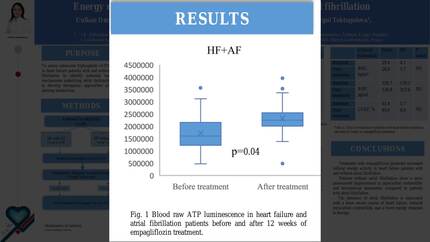
After treatment with empagliflozin in vivo, a statistically significant increase in ATP levels (p<0.05) was observed in group 1 patients and HF without AF (group 2) (Table 1, 2). Moreover, in patients of group 2, a tendency towards a more pronounced increase in ATP levels was observed (p=0.43). According to the Minnesota Living with Heart Failure questionnaire, patients of both groups reported an improvement in the quality of life (decrease in the total score compared to the baseline). Clinically, group 1 manifested by a decrease in the level of BNP (from 263.2±360.8 pg/ml to 176.4±186.3 pg/ml) and a slight increase in LVEF (from 38.6±7.8% to 39.6±8.3%). In patients group 2, the dynamics were more pronounced: BNP decreased from 129.7±179.1 pg/ml to 126.8±213.6 pg/ml, and LVEF from 41.4±5.7% to 45.0±8.8%.
Treatment with empagliflozin promotes increased cellular energy activity in HF patients with and without AF. Patients without AF show a more pronounced improvement in myocardial contractility and biochemical parameters compared to patients with AF. The presence of AF is associated with a more severe course of heart failure, reduced myocardial contractility, and a lower energy response to therapy.
Contributors


A Turdubaev
Author
National Center of Cardiovascular Surgery and Organ Transplantation Bishkek , Kyrgyzstan
M Breidert
Author
M Moldobaeva
Author
N Toktogulova
Author
P Eftekhari
Author
You may be interested in