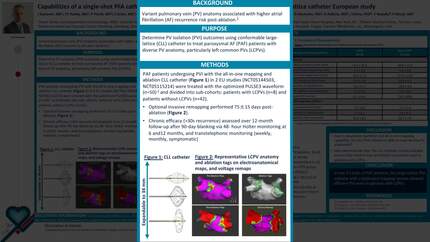
Capabilities of a single-shot pulsed field ablation to treat left common pulmonary veins: results from the conformable large-lattice catheter European study
EP Europace Journal


Abstract
Variant pulmonary vein (PV) anatomy is associated with higher atrial fibrillation (AF) recurrence risk post-ablation. In this analysis, we examine PV isolation (PVI) outcomes utilizing the conformable large-lattice catheter (CLL) in treating patients with paroxysmal atrial fibrillation (PAF) and diverse PV anatomy.
To determine PVI outcomes in PAF patients with left common PVs (LCPVs) treated with the CLL catheter.
The CLL catheter (Sphere-360, Medtronic), which is over-the-wire, single-shot, and an all-in-one mapping and pulsed field ablation (PFA) catheter, was guided through a steerable sheath into the left atrium to map PV anatomy. Pre-procedure imaging to assess PV anatomy was not required. PVI was achieved by placing the catheter into each PV ostium and delivering PF energy while moving antrally between applications. Three pulse waveforms (i.e., PULSE1, PULSE2, and the optimized PULSE3) were evaluated. Optional invasive remapping was performed 75±15 days post-ablation and >30s AF/AFL/AT recurrence was assessed over 12 months following a 90-day blanking period.
One-hundred patients underwent PVI with PULSE1 (n=30), PULSE2 (n=20), or PULSE3 (n=50). Within PULSE3, ablation parameters were consistent across PV anatomies, including applications/PV (4.7±1.1) and transpired PVI ablation time (13.4±7.8 minutes). Eight PULSE3 patients had a LCPV, and acute isolation was achieved in all 24 targeted PVs. Overall, 7.1±1.5 applications were used to isolate LCPVs (with 41.6±8.6 seconds of PF energy), while maintaining the standard number of 4.6±1.3 applications for other PVs in PULSE3. LCPV ablation time averaged 3.7±2.6 minutes versus 2.6±4.8 for other PULSE3 PVs. All 24 PVs remained isolated at remap. At 12 months, 87.5±11.7% of LCPV patients and 85.7±5.4% of the remaining PULSE3 patients were recurrence-free.
These data demonstrate efficient workflow and optimal outcomes across various PV anatomies with the CLL catheter.
Contributors



You may be interested in