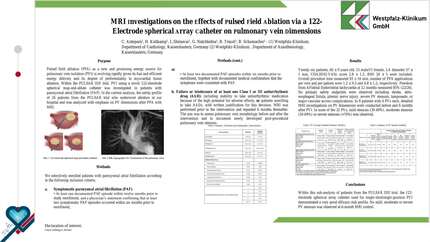
MRI investigations on the effects of pulsed field ablation via a 122-electrode spherical array catheter on pulmonary vein dimensions
EP Europace Journal


Abstract
Pulsed field ablation (PFA) as a new and promising energy source for pulmonary vein isolation (PVI) is evolving rapidly given its fast and efficient energy delivery and its degree of preferentiality to myocardial tissue ablation.
Within the PULSAR IDE trial, PVI using a novel 122-electrode spherical map-and-ablate catheter was investigated in patients with paroxysmal atrial fibrillation (PAF). In the current analysis, the safety profile of 26 patients from the PULSAR trial who underwent ablation at the our hospital was analyzed with emphasis on PV dimensions after PFA.
Twenty-six patients, 66 ± 9 years old, 15 male/11 female, LA diameter 37 ± 1 mm, CHA2DS2-VASc score 2.8 ± 1.3, BMI 28 ± 5 were included. Overall procedure time measured 93 ± 16 min, number of PFA applications per vein and per patient were 1.2 ± 0.5 and 4.8 ± 1.2, respectively. Freedom from AF/atrial flutter/atrial tachycardia at 12 months measured 85% (22/26). No primary safety endpoints were observed including stroke, atrio-esophageal fistula, phrenic nerve injury, severe PV stenosis, tamponade, or major vascular access complications. In 8 patients with 4 PVs each, detailed MRI investigations on PV dimensions were conducted before and 6 months after PVI. In none of the 32 PVs, mild stenosis (30-49%), moderate stenosis (50-69%) or severe stenosis (>70%) was observed.
Contributors

You may be interested in