Empirical superior vena cava ablation added to pulmonary vein isolation more effective for persistent atrial fibrillation
EP Europace Journal


Abstract
Pulmonary vein isolation (PVI) is useful for atrial fibrillation (AF). Superior vena cava (SVC) is one of the triggers of atrial fibrillation and SVC isolation (SVC-I) is applicable for some AF patients. However, long-term efficacy of PVI plus empiric SVC-I for treatment of AF is controversial.
We evaluated the efficacy of empirical SVC-I added to pulmonary vein isolation (PVI).
We retrospectively investigated consecutive AF patients who were performed PVI from February 2020 to July 2022. Superior vena cava isolation was performed for operator’s decision regardless of SVC sleeve length. Exclusion criteria were as follows: previous cardiac surgery, previous ablation for AF, follow-up periods under one-year and unsuccessful SVC-I cases. Definition of recurrence was the confirmation of atrial tachyarrhythmias (ATs) after blanking periods.
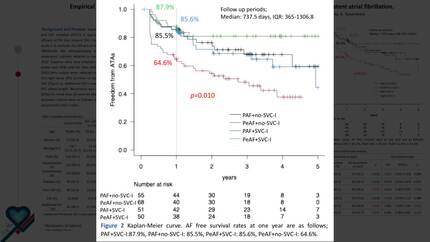
Consecutive 185 patients were analyzed. Sixty-five patients were recurrent ATs. Persistent AF, prior CHF, left ventricular ejection fraction (LVEF), SVC-I were significantly different in univariate analysis (44Pts vs 56Pts, p=0.008, 12Pts vs 9Pts, p=0.031, 59% vs 64%, p=0.014, 23Pts vs 70 Pts, p=0.003, respectively). Moreover, Persistent AF and SVC-I were significant differences for recurrence of ATs in Cox hazard model. In paroxysmal AF patients, there were no significant differences whether SVC-I or not. However, in persistent AF patients, additional SVC-I was lower recurrence than no SVC-I group
Pulmonary vein isolation plus empiric SVC-I may be effective for persistent AF patients. Kaplan-meier curve
Contributors

T Nishikawa
Author
C Yamazaki
Author
T Minoura
Author
M Nakamura
Author
T Taki
Author
S Nonaka
Author
F Ishibashi
Author
H Kato
Author
N Nakamura
Author
M Ozeki
Author
T Kanda
Author
K Tawarahara
Author
You may be interested in