Temporal association of premature ventricular contraction burden measured by an insertable cardiac monitor with episodes of ventricular tachycardia and fibrillation
EP Europace Journal


Abstract
Insertable cardiac monitors (ICM) have the capability to continuously monitor PVC burden over time as well as detect ventricular tachycardia and fibrillation (VT/VF).
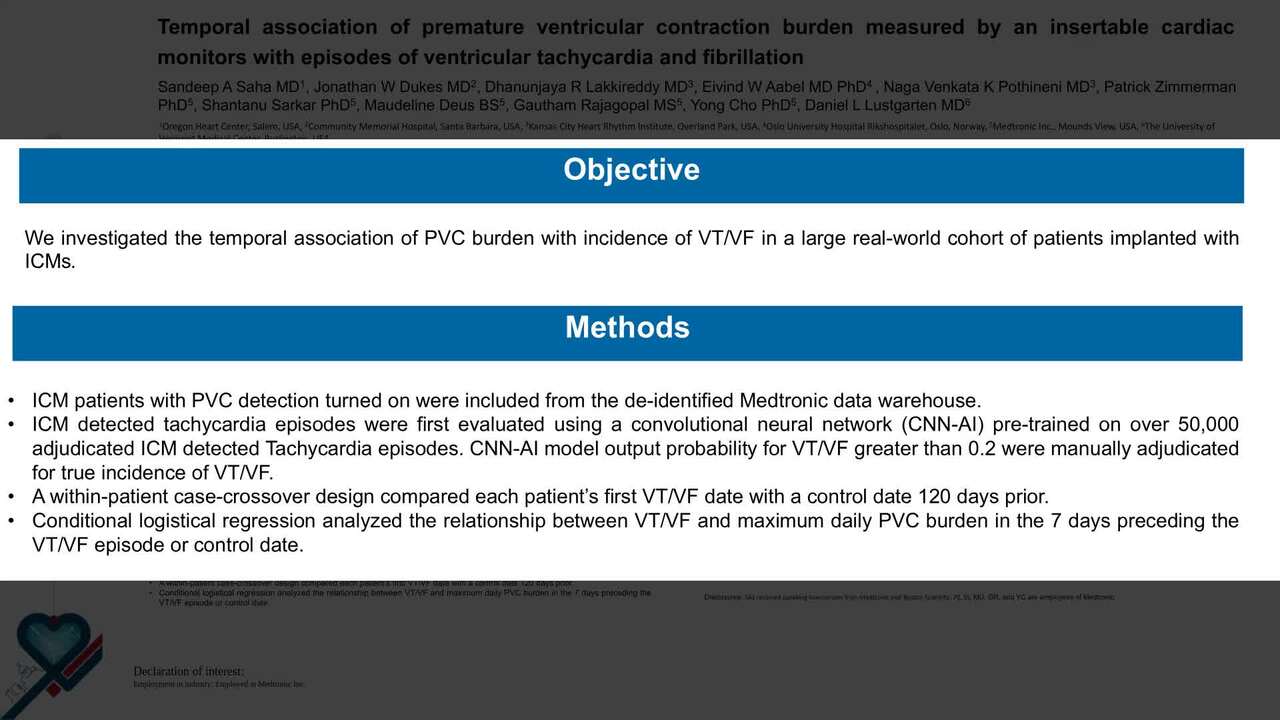
We investigated the temporal association of PVC burden with incidence of VT/VF in a large real-world cohort of patients implanted with ICMs.
Patients implanted with an ICM for various monitoring reasons and with PVC detection enabled were included from a de-identified device data warehouse. Tachycardia episodes detected by the ICM were first evaluated using an artificial intelligence (AI) model pre-trained using >50,000 adjudicated ICM detected Tachycardia episodes. If the AI-model output probability for VT/VF was greater than 0.2, then those episodes were manually adjudicated for true incidence of VT/VF. A within-patient case-crossover design compared each patient’s first VT/VF date with a control date 120 days prior. Conditional logistic regression analyzed the relationship between VT/VF and maximum daily PVC burden in the 7 days preceding the VT/VF episode or control date.
A total of 14,125 patients (average age: 66.5±15.1 years, 50% males) were included in the analysis, of which 13,552 patients never had VT/VF, and had significantly lower overall PVC burden than patients with true VT/VF (Figure). A total of 1322 true VT/VF episodes in 573 patients were identified after AI-model probability based manual adjudications, of which 299 patients were identified with at least 150 days of PVC burden data before their first true VT/VF episode. Among these patients, maximum daily PVC burden in the 7 days prior to their first VT/VF episode was 32% higher than in the 7 days prior to the control date (p=0.005). A 1% increase in maximum daily PVC burden was associated with a 14% increase in the odds of VT/VF (OR: 1.14 95% CI:1.05-1.24, p=0.001). Additionally, a 7-day maximum daily PVC burden of >=10% was associated with a >6-fold increase in the odds of developing VT/VF (OR: 6.33 (1.87-21.4), p<0.001).
PVC burden was significantly higher in patients with VT/VF than those with no VT/VF, and further increased in the 7 days prior to occurrence of their first VT/VF episode. Having at least one day with PVC burden >=10% during a 7-day period was associated with more than a 6-fold increase in the odds of acute-onset VT/VF. Temporal characteristics of continuously monitored PVC burden in ICMs may be used as a tool to identify patients at risk for VT/VF.
Contributors


D R Lakkireddy
Author

N V K Pothineni
Author
P Zimmerman
Author

M Deus
Author
D L Lustgarten
Author
The University of Vermont Medical Center Burlington , United States of America
You may be interested in