Electromagnetic interference during epicardial ablation in a patient with an extravascular implantable cardioverter-defibrillator and arrhythmogenic right ventricular cardiomyopathy: a case report
European Heart Journal - Case Reports


Abstract
Arrhythmogenic cardiomyopathy (ACM) is an inherited disease characterized by fibrofatty replacement, most often involving the right ventricle but potentially affecting the left or both ventricles. It predisposes to severe ventricular arrhythmia (VA). Differentiating ACM from athlete’s heart remains difficult, particularly in gene-elusive patients. Implantable cardioverter-defibrillators (ICDs) and catheter ablation are key therapeutic options. Epicardial ablation may be required for VA circuits inaccessible in an endocardial approach, but data on its feasibility in patients with extravascular ICD (EV-ICD) featuring a retrosternal lead is scarce.
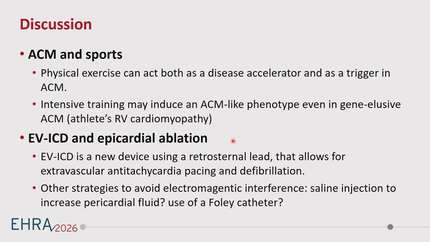
A 42-year-old male athlete was admitted for syncope due to sustained ventricular tachycardia (VT) during exertion. Cardiac magnetic resonance imaging (CMR) showed a dilated right ventricle (RV) with wall akinesia and fibrosis involving the RV outflow tract. Genetic testing was negative. The diagnosis of borderline gene-elusive ACM was made. An EV-ICD was implanted for secondary prevention. Recurrent sustained VT prompted endocardial and epicardial ablation, which was feasible and successful, but radiofrequency energy application was hampered close to the retrosternal lead due to electromagnetic interference.
This case highlights the diagnostic and therapeutic challenges of ACM in athletes. Epicardial ablation is feasible even with an EV-ICD, although electromagnetic interference may complicate ablation near the lead. High-level endurance exercise can induce ACM-like remodelling, creating phenotypic overlap with gene-elusive ACM. Early recognition, tailored ablation strategies, and appropriate device therapy are essential for the management of these patients.
Contributors


Feifan Ouyang
Author
Alexander Breitenstein
Author
Firat Duru
Author
Ardan M Saguner
Author
A Ashika
Author
Asmaa El Abbady
Author
Deepti Ranganathan
Author
You may be interested in