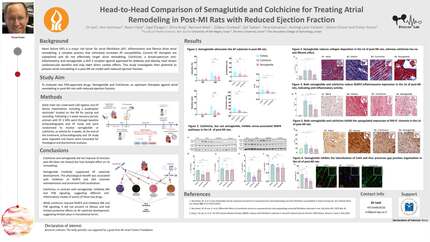
Differential effects of semaglutide and colchicine on atrial remodeling in rats with reduced ejection fraction after myocardial infarction
EP Europace Journal


Abstract
Atrial fibrillation (AF) is strongly associated with adverse outcomes, particularly in patients with heart failure (HF). AF susceptibility is driven by atrial remodelling, including electrical disarray, inflammation, and fibrosis, yet current therapies do not adequately target the underlying substrate. Semaglutide, a glucagon-like peptide-1 (GLP-1) receptor agonist, and colchicine, a broad-spectrum anti-inflammatory agent, have demonstrated cardiovascular benefits, but their effects on atrial remodelling remain unclear. We evaluated the effects of both drugs on atrial remodelling in post-myocardial infarction (MI) rats with reduced ejection fraction.
Male rats underwent MI together with implantation of a chronic atrial pacing and recording system. One-week post-MI, animals with left ventricular ejection fraction ≤40% were randomized to semaglutide (40 µg/kg subcutaneously every 72 h), colchicine (100 µg/kg intraperitoneally daily), or vehicle for 21 days. Serial electrophysiological testing, echocardiography, histology, and molecular analyses were performed to characterize the AF substrate. Both semaglutide and colchicine reduced AF inducibility and AF duration, whereas semaglutide additionally reduced atrial signal complexity. Semaglutide attenuated atrial fibrosis, suppressed NOD-like receptor pyrin domain-containing protein 3 (NLRP3) inflammasome expression, prevented connexin-43 (Cx43) lateralization, and reduced expression of the proarrhythmic small-conductance calcium-activated potassium channel 4 (SK4). Colchicine reduced NLRP3 and SK4 expression and inhibited p38, c-Jun N-terminal kinase (JNK), and protein kinase B (AKT) signalling, but did not prevent fibrosis or Cx43 remodelling.
In the post-MI HF setting, both drugs demonstrated anti-arrhythmic and anti-remodelling effects. Their differential actions suggest that multiple pathways can be targeted to limit AF substrate progression.
Contributors


Noam Dalal
Author
Aviv Komissar
Author
Daniel Moldavsky
Author
Salma Khamaisi
Author
Sigal Elyagon
Author
Adir Eliyahu
Author
Shira Burg
Author
Bernard Attali
Author
Daria Makarovsky
Author
Alexandra Lichtenstein
Author
Gideon Gradwohl
Author

Yana Kakzanov
Author
Avishag Laish-Farkash
Author
Sharon Etzion
Author

You may be interested in