Novel machine learning fusion architectures integrating electrocardiogram representations: applications to acute coronary event detection
European Heart Journal - Digital Health


Abstract
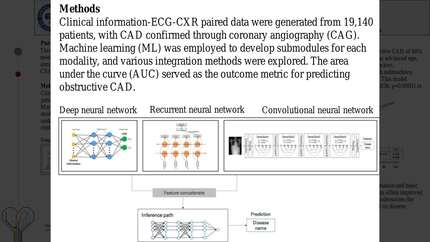
AI in electrocardiography (ECG) has diverged into two paths: traditional signal processing with machine learning, and deep learning of raw waveforms. The former preserves physiological interpretability but may miss novel patterns, while the latter overlooks a century of ECG science. No framework yet integrates both. This study introduces a fusion model combining handcrafted feature-based random forest and waveform-based convolutional neural network to improve the diagnosis of acute coronary events.
This prospective, multicentre cohort study included pre-hospital ECGs recorded on emergency medical services from patients with a chief complaint of chest pain. Using this dataset, we developed four fusion frameworks that integrate ECG features with waveform information: (1) decision-level fusion combining predictions from random forest and convolutional neural network (CNN); (2) decision-level fusion with retraining; (3) feature-level fusion by concatenating CNN embeddings with ECG features; and (4) feature-level fusion combining CNN embeddings with tree-level outputs from the random forest. This study comprised of 10 393 ECGs from 7397 patients. On both outcomes, acute coronary syndrome and occlusion myocardial infarction, the proposed decision fusion with retraining (Approach 2) achieved an AUROC of 0.878 (95% CI, 0.837–0.915) and 0.961 (95% CI, 0.934–0.983) on the test set and an average precision score of 0.749 (95% CI, 0.681–0.810) and 0.850 (95% CI, 0.763–0.918), respectively, outperforming all other proposed fusion and individual models.
This study demonstrates the significance of fusion models that integrate complementary ECG representations to improve diagnostic accuracy in acute coronary events, highlighting a promising approach for real-time AI-augmented cardiovascular disease detection across diverse use cases.
Contributors

Rui Qi Ji
Author
Nathan T Riek
Author
Tanmay Gokhale
Author
Upmc University Of Pittsburgh Medical Center Pittsburgh , United States of America
Zeineb Bouzid
Author
Karina Kraevsky
Author
Jessica K Zègre-Hemsey
Author
Samir Saba
Author
Christian Martin-Gill
Author
Clifton W Callaway
Author
Murat Akcakaya
Author
Ervin Sejdić
Author
Salah S Al-Zaiti
Author
You may be interested in