Circulating miR-10b-5p as a candidate biomarker of atrial fibrillation recurrence after catheter ablation: a two-phase translational study
EP Europace Journal


Abstract
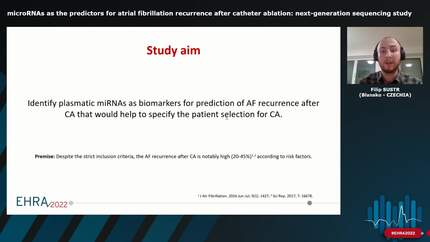
The identification of reliable biomarkers for atrial fibrillation (AF) recurrence post-catheter ablation remains a clinical challenge. This study aimed to identify circulating microRNAs (miRNAs) associated with post-ablation AF recurrence and examine their underlying molecular pathways using an integrative translational approach.
This two-phase study included a discovery case-control phase (
Down-regulation of circulating hsa-miR-10b-5p was independently associated with AF recurrence after catheter ablation and improved risk discrimination beyond clinical variables. These findings support its potential role as a prognostic biomarker, although further multicentre validation is required before clinical application.
Contributors

Εmmanouil P Vardas
Author
St Bartholomew's Hospital London , United Kingdom of Great Britain & Northern Ireland

Stylianos Tzeis
Author
Panagiotis Theofilis
Author
Maria Gazouli
Author
Eleni Papadogeorgaki
Author
Konstantinos Belogiannis
Author
Dimitrios Asvestas
Author
Emmanouil Vavouris
Author
Dimitrios Charitos
Author
Dimitris Tousoulis
Author
You may be interested in