Artificial intelligence–based quantification of breast arterial calcifications to predict cardiovascular morbidity and mortality
European Heart Journal


Abstract
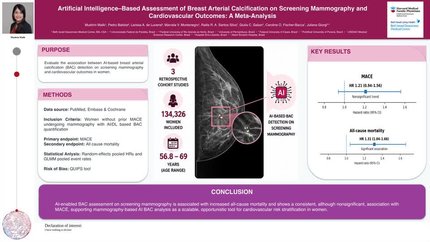
Women are underdiagnosed and undertreated for cardiovascular disease (CVD). Automatic quantification of breast arterial calcification (BAC) on screening mammography can identify women at risk for CVD. This study aimed to determine whether artificial intelligence–based automatic quantification of BAC from screening mammograms predicts CVD and mortality beyond PREVENT scores in a large, racially diverse, multi-institutional population.
This retrospective cohort study included 123 762 women from two healthcare systems who had screening mammograms. Breast arterial calcification was quantified using a transformer-based neural network for segmentation. Breast arterial calcification severity was categorized as zero (0 mm2), mild (>0–10 mm2), moderate (>10–25 mm2), and severe (>25 mm2). Kaplan–Meier analysis, Cox proportional hazards, and Fine–Gray competing event models were used to examine the association between BAC and major adverse cardiovascular events (MACE).
Breast arterial calcification was detected in 16.1% (internal cohort) and 20.6% (external cohort) of women and provided significant prognostic value incremental to the PREVENT score. In PREVENT adjusted models, a clear dose–response was observed. Compared with zero BAC, mild [internal: hazard ratio (HR) 1.32, 95% confidence interval (CI) 1.10–1.59; external: HR 1.28, 95% CI 1.17–1.39], moderate (internal: HR 1.75, 95% CI 1.23–2.50; external: HR 1.79, 95% CI 1.55–2.06), and severe BAC (internal: HR 3.29, 95% CI 2.15–5.05; external: HR 2.80, 95% CI 2.36–3.32) were all prognostic for any MACE. Each 1 mm2 increase in BAC conferred an additional 2%–3% risk for MACE (
Automatically quantified BAC is an independent predictor of MACE and mortality, adding prognostic value to the PREVENT score. This approach may provide an opportunistic cardiovascular risk assessment during routine mammography screening without additional radiation exposure to guide earlier and more effective preventive care for women.
Contributors

Laurence Sperling
Author
Judy Gichoya
Author
Marly van Assen
Author
W Charles O’Neill
Author
Imon Banerjee
Author
Hari Trivedi
Author
Theodorus Dapamede
Author
Aisha Urooj
Author
Vedant Joshi
Author
Gabrielle Gershon
Author
Frank Li
Author
Mohammadreza Chavoshi
Author
Beatrice Brown-Mulry
Author
Rohan Satya Isaac
Author
Aawez Mansuri
Author
Chad Robichaux
Author
Chadi Ayoub
Author
You may be interested in