When vesicles turn pathogenic: circulating evs trigger endothelial dysfunction in HFpEF
Cardiovascular Research


Abstract
Systemic inflammation plays a key role in the development of heart failure with preserved ejection fraction (HFpEF), though the precise inflammatory mechanisms affecting the heart remain unclear. The involvement of extracellular vesicles (EVs) in the pathogenesis of HFpEF has not yet been explored. Herein, we tested the hypothesis that circulating EVs deliver deleterious signaling to the myocardium inducing endothelial dysfunction and fibrosis.
Circulating EVs were isolated from HFpEF (HFpEF EVs) and comorbidity-matched control patients, characterized by the absence of clinical, analytical or imaging evidence of HF (CTRL EVs). The biological effects of EVs and of their cargo on vascular dysfunction and cardiac fibrosis was then investigated by combining proteomics and in vitro, ex vivo and in vivo functional assays.
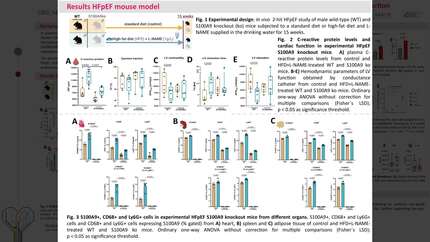
HFpEF EVs induced endothelial dysfunction, demonstrated by higher levels of inflammatory activation, monocyte adhesion and cell senescence in vitro, and endothelial-dependent relaxation impairment in ex vivo functional tests, compared to CTRL EVs. Furthermore, the secretome of endothelial cells exposed to HFpEF EVs promoted higher levels of fibroblast-to-myofibroblast transition in vitro. Proteomic analysis unveiled S100A9 enrichment in HFpEF EVs. Subsequent pharmacological inhibition of S100A9 or its primary receptor, TLR4, attenuated the deleterious effect of HFpEF EVs on endothelial function and prevented the pro-fibrotic phenotype. Using a relevant model of HFpEF, "the two hit model", we demonstrated that inhibition of S100A9 attenuated important hallmarks of HFpEF.
Our results establish a causal link between circulating EVs and microvascular dysfunction as well as cardiac fibrosis in patients with HFpEF, identifying the S100A9-TRL4 pathway as main mediator of these effects.
Contributors

J F Dias-Ferreira
Author
P Pusceddu
Author
T Zhelezovskaya
Author
P Mendes-Ferreira
Author
B Barreira
Author
F Vasques Novoa
Author
S Santos
Author
N Santarem
Author
A Leite Moreira
Author
P Pinto O
Author
R Vitorino
Author
F Perez-Vizcaino
Author
D S Nascimento
Author
You may be interested in