The effect of chronic exogenous ketone use on aortic responses in male and female HFpEF rats
Cardiovascular Research


Abstract
Approximately half of the patients diagnosed with heart failure have preserved ejection fraction (HFpEF). HFpEF is a heterogeneous clinical syndrome caused by various conditions. Obesity, diabetes, hypertension, and aging are prominent contributors to the pathology of heart failure. HFpEF is also associated with inflammation. The elevation of blood pressure and inflammation cause endothelial dysfunction.
The aim of this study is to induce an HFpEF model in male and female rats through obesity and hypertension, and to observe the effect of exogenous ketone use on aortic responses of the model.
The animals were exposed to a high fat diet and L-NAME for 10 weeks. For the last 4 weeks, some of the animals were treated with 1,3-propanediol, the precursor of a ketone: beta-hydroxybutyrate (β-OHB). Tail-cuff and oral glucose tolerance tests were used to evaluate blood pressure and the metabolic profile, respectively. The heart function was evaluated via echocardiography and in vivo Pressure-Volume (PV) loop analysis. The aortic function was assessed using the concentration-response to phenylephrine, acetylcholine and sodium nitroprusside in an organ bath. The relaxant effect of βOHB was also assessed in the presence of various inhibitors.
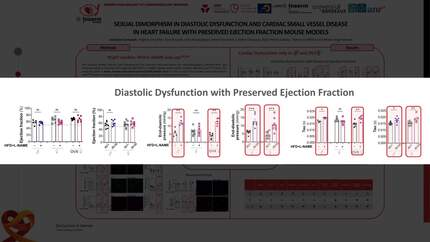
Diastolic dysfunction was observed in the echocardiography, with a more aggressive pattern in male rats. PV loop analysis showed elevated blood pressure in HFpEF animals, but no change in EDV or dp/dt. In the organ bath, the responses to phenylephrine and acetylcholine were lower in HFpEF rat aortas. Interestingly, βOHB induced relaxations in preconstricted aortas which were higher in female aortas compared to male aortas. These relaxations were almost completely inhibited by mechanical disruption of the endothelium and partially inhibited by L-NAME.
We present a rat model HFpEF of with a different pattern in male and female animals. Furthermore, we demonstrate that the ketone βOHB causes endothelium-dependent relaxation in the rat aorta.
Contributors


Y Soylu
Author
N S Kosumcu
Author
E A Arslan
Author
O S Terzi
Author
E Arioglu-Inan
Author
A Isam Ismael Ismael
Author
You may be interested in