Volumetric bioprinting of VoluHearts: a next-generation cardiac in vitro model
Cardiovascular Research


Abstract
The rationale for developing predictive cardiac models is twofold: first, to investigate pathophysiology and identify new therapeutic strategies for cardiac diseases; and second, to evaluate new pharmacological agents for potential cardiotoxic effects, which have the highest incidence amongst adverse drug reactions (1). Current in vitro models struggle to capture the native architecture of the heart, consequently limiting the assessment of cardiac functional outputs (2).
To overcome these limitations, we introduce VoluHeart, a cardiac in vitro model that has the potential to serve as a high-throughput platform for disease modeling with clinical output measurements.
Bi-chambered VoluHearts, composed of induced pluripotent stem cell-derived cardiomyocytes (iPSC-CMs) and cardiac fibroblasts (10:1), were 3D printed using an ultra-fast volumetric bioprinter. This innovative approach utilizes a projected light pattern to solidify a light-sensitive gel containing cells into a desired architecture (3). The cells were embedded in HybriGel (4) or conventional gelatin methacryloyl (GelMA). HybriGel is a newly developed hydrogel that forms covalent and supramolecular interactions. The resulting dynamic matrix promotes both cell-cell connections and structural stability. Cell viability and network formation were compared between the two gels using live/dead assays and immunofluorescence. Further characterization of VoluHearts included beating rate, immunofluorescence, and calcium handling analysis. To validate the disease modelling capabilities of VoluHearts, we introduced an apical cryoinjury, which was subsequently assessed using various readouts, including beating rate and calcium handling.
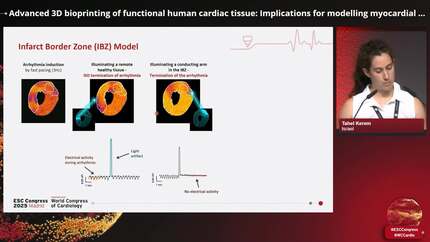
The design flexibility of volumetric bioprinting enabled the printing of bi-chambered symmetric VoluHearts (~ 165 mm³) and a 4-chambered heart replica within 21 seconds (Figure 1A). iPSC-CMs in HybriGel demonstrated superior network formation compared to GelMA over a 2-week culture period (Figure 1B). Within one week, VoluHearts exhibited spontaneous contractions and directional calcium waves. Immunofluorescence imaging confirmed the alignment of iPSC-CMs along the septum and chamber walls (Figure 1C). To model a myocardial infarction, a cryoinjury was applied to the apex, resulting in localized disruption of electromechanical coupling (Figure 1D).
VoluHeart represents a novel in vitro cardiac model that combines volumetric bioprinting, dynamic biomaterials, and iPSC-CMs to recreate anatomically relevant heart structures. Its scalability, compatibility with experimental and clinical readouts, and responsiveness to injury highlight its potential as a platform for disease modeling and high-throughput drug screening.
Contributors

P Nunez Bernal
Author
N Chirico
Author
G Groessbacher
Author
M Falandt
Author
A Cervera I Barea
Author
S Florczak
Author
I Dokter
Author
C J B Snijders Blok
Author
J Malda
Author
J P G Sluijter
Author
R Levato
Author
A Van Mil
Author