Neurofilament light chain and neuron-specific enolase for estimating long-term cognitive function after cardiac arrest
European Heart Journal - Acute CardioVascular Care


Abstract
Survivors of cardiac arrest often have neurologic deficits that persists after hospital discharge. Neurofilament light chain (NfL) and neuron-specific enolase (NSE) are blood biomarkers that provide information on brain injury in the acute setting and can be used for prediction of poor neurologic outcome. However, it is not clear if a more granular estimation of long-term cognitive function based on these blood tests is possible. Currently only NSE has been recommended by guidelines for neuroprognostication after cardiac arrest, however, efforts to integrate NfL into clinical practice are ongoing.
To determine if NfL and NSE measured 48 hours after cardiac arrest are associated with long-term cognitive function.
Patients from The Blood Pressure and Oxygenation Targets after Cardiac Arrest (BOX) trial who had both NfL and NSE samples available and completed a follow-up visit were included in this investigation. All patients in the BOX trial had been resuscitated from out-of-hospital cardiac arrest and were comatose on admission. NfL and NSE were quantified by ELISA method in EDTA plasma collected 48 hours after cardiac arrest and stored in a biobank until completion of the trial. Cognitive function was assessed by the Montreal cognitive assessment (MoCA) score at follow-up; the score ranges from 0 (worst) 30 (best); a score ≥26 is classified as normal cognition, 18-25 as mild impairment, 10-17 as moderate impairment, and 0-16 as severe impairment. Spearman’s correlation analysis was used to examine the relationship for NfL and NSE against MoCA score.
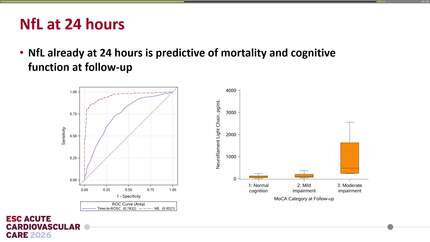
Of the 789 patients included in the BOX trial, 195 survivors had both NSE and NfL samples as well as a MoCA test performed and were included in this investigation. For this cohort the median NfL was 104 pg/mL (58-209) and NSE was 14.7 µg/L (9.6-22.1) after 48 hours. At follow-up the MoCA score was 27 (25-29). For NfL and NSE according to cognitive function see figures 1 and 2. NfL was inversely correlated with MoCA score (r=-.36, p<0.001), while NSE had no association (r=0.08, p=0.25).
After cardiac arrest, NfL measured as early as 48 hours after cardiac arrest is related to long term cognitive function. This was not found for NSE. Thus, the introduction of routine early NfL measurement could potentially aid in identification of patients with higher risk for cognitive impairment, and enable better guidance for clinicians, patients, and families. NfL levels according to MoCA-category NSE levels according to MoCA-category
Contributors


R Beske
Author
S Moelstroem
Author
S Schneekloth
Author
C Christoffersen
Author

J Moeller
Author
J Kjaergaard
Author

You may be interested in