Ultrasound-guided decongestion using the VExUS protocol enhances NT-proBNP reduction in acute decompensated heart failure
European Heart Journal - Acute CardioVascular Care


Abstract
Residual congestion at discharge remains one of the strongest predictors of early rehospitalization and death in acute heart failure. However, defining euvolemia during hospitalization is challenging since clinical, radiographic, and laboratory parameters lack sensitivity to detect persistent venous overload. The Venous Excess Ultrasound (VExUS) protocol provides a novel, non-invasive, Doppler-based assessment of systemic venous congestion. VExUS-guided depletive therapy could optimize fluid removal, reduce residual congestion, and enhance NT-proBNP reduction at discharge.
We hypothesized that guiding depletive therapy using the VExUS protocol, by integrating a quantitative assessment of systemic venous congestion, would achieve a greater reduction in NT-proBNP at discharge compared with conventional, clinically guided management in patients hospitalized for acute decompensated heart failure.
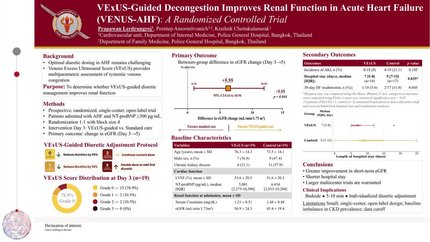
We conducted a single-center, prospective, randomized, open-label trial including adults with acute decompensated heart failure and evidence of systemic congestion (NT-proBNP above age-adjusted thresholds, CCS ≥ 1, VExUS > 0). Participants were randomized 1:1 to receive either standard depletive therapy guided by clinical, radiographic, and laboratory criteria or daily VExUS-guided therapy. In the VExUS arm, physicians tailored diuretics based on daily scores, and discharge required VExUS = 0 (ultrasonographic euvolemia); in controls, discharge required CCS = 0 (clinical euvolemia). The primary endpoint was percentage NT-proBNP reduction from admission to discharge; secondary endpoints included changes in body weight and CCS, and safety outcomes (AKI KDIGO 3, severe hyponatremia, hypokalemia).
Forty-four patients were randomized (22 per group). Baseline characteristics were balanced except for higher hypertension prevalence in the VExUS group (63 % vs 27 %; p = 0.03). NT-proBNP reduction was numerically greater with VExUS (60 % [46–83] vs 53 % [30–79]; p = 0.36), corresponding to higher absolute delta values (8954 [2202–15 827] vs 5861 [2891–9540] pg/mL). Weight loss was also greater in the VExUS arm (9.3 [3.3–21.2] kg vs 7.5 [5.2–11.1] kg; p = 0.60). No significant differences were observed in renal or electrolyte complications.
Daily VExUS-guided therapy achieved effective and safe decongestion comparable to standard care, with consistent trends toward greater NT-proBNP and weight reduction at discharge. These findings support VExUS as a feasible bedside tool to individualize depletive therapy and potentially improve congestion-resolution strategies in acute heart failure.
Contributors



You may be interested in