Achieved LDL-C levels <55 mg/dL and cardiac events in patients and lesions harbouring lipid-rich plaque phenotypes
European Heart Journal - Cardiovascular Imaging


Abstract
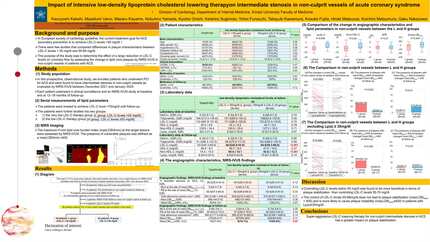
The European Society of Cardiology guidelines recommend low-density lipoprotein cholesterol (LDL-C) < 55 mg/dL in very-high-risk patients. Given that plaque phenotype underscores its modulatory response to lipid-lowering therapies, patients and lesions harbouring lipid-laden plaques may benefit from LDL-C < 55 mg/dL to reduce their cardiovascular risks.
The REASSURE-NIRS (REvelation of PAthophySiological PhenotypeS of VUlneRable Lipid-Rich PlaquE on Near-InfraRed Spectroscopy) multi-centre registry enrolled 853 coronary artery disease patients (non-culprit lesions = 1662) receiving NIRS/IVUS-guided PCI (NCT04864171). LDL-C level at 3 months after PCI was used as on-treatment LDL-C. Study subjects were stratified according to maxLCBI4mm at non-culprit lesions < vs. ≥324.7. In each group, major adverse cardiac events (MACE) (=cardiac-cause death + non-fatal myocardial infarction (MI) + ischaemia-driven non-culprit lesion revascularization) was compared in those with on-treatment LDL-C < vs. ≥55 mg/dL. 31.6% of study subjects achieved on-treatment LDL-C < 55 mg/dL. During the observational period (median = 1109 days), MACE rate did not differ in patients with maxLCBI4mm < 324.7 exhibiting on-treatment LDL-C levels < and ≥55 mg/dL [adjusted hazard ratio (HR) = 1.42, 95% confidence interval (CI) = 0.80–2.54,
NIRS-derived lipid-rich plaque may be a potential imaging measure reflecting patients and lesions that may benefit from achieving LDL-C levels < 55 mg/dL.
Contributors

Stephen J Nicholls
Author
Eri Kiyoshige
Author
Kunihiro Nishimura
Author
Rishi Puri
Author


Kentaro Mitsui
Author
Yoshiyuki Tomishima
Author
Kenichiro Sawada
Author
Hideo Matama
Author
Takamasa Iwai
Author
Satoshi Honda
Author
Kazuhiro Nakao
Author
Masashi Fujino
Author
Kensuke Takagi
Author
Shuichi Yoneda
Author
Fumiyuki Otsuka
Author
Kensaku Nishihira
Author
Itaru Takamisawa
Author
Teruo Noguchi
Author
You may be interested in