Current practice of European operators in the treatment of bifurcation lesions in patients with multivessel disease and data collection for the MADS-2 classification: insights from Multivessel TALENT
European Heart Journal Supplements


Abstract
Bifurcation lesions continue to represent a challenging subset in interventional cardiology, being associated with lower procedural success, higher complication rates, and an increased risk of adverse cardiac events during long-term follow-up. To enable consistent reporting and comparison of bifurcation stenting techniques, standardisation of procedural classifications and technical sequences is essential. In response to this need, the European Bifurcation Club (EBC) proposed the Main-Across-Distal-Side 2 (MADS-2) classification, providing a unified framework for the description and application of bifurcation PCI strategies.
We aimed to evaluate the feasibility of applying the MADS-2 classification system in a randomised PCI trial (Multivessel TALENT) of patients with de novo three-vessel disease (3VD) without left main disease, and to report contemporary treatment strategies for bifurcation lesions adopted by European operators.
The Multivessel TALENT trial is a randomised, 1:1, multicentre (54 centres in Europe), open-label study comparing clinical outcomes between the Supraflex CruzTM and SYNERGYTM in patients with de novo 3VD without left main disease. The best PCI practice encompasses Heart Team consensus based on SYNTAX score II, functional lesion evaluation with quantitative flow ratio (QFR) by independent corelab, stent optimization by intravascular imaging and prasugrel monotherapy following 1-month DAPT. For each bifurcation lesion treated with drug-eluting stents (DES), investigators documented the corresponding MADS-2 classification in the electronic case report form (e-CRF).
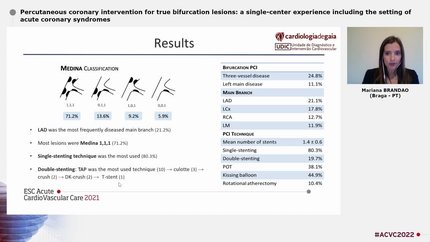
In the current trial, 595 of 4,052 treated lesions were bifurcations treated with DES. The e-CRF–based MADS-2 classification was completed for all bifurcation lesions (100%). Of the 595 bifurcation lesions, 410 (68.9%) were treated using a single-stent strategy, most commonly main branch crossover stenting with subsequent proximal optimization technique (POT). (Figure 1A) The remaining 185 lesions (31.1%) underwent double-stent techniques, predominantly the culotte technique, followed by the step/DK-crush approach. (Figure 1B). As the MVT trial targeted patients with de novo 3VD, Double stenting techniques were relatively more frequently selected compared with historical cohorts. (Figure B)
Application of the e-CRF-based MADS-2 classification system was feasible across a large 3VD RCT, demonstrating the practicality of standardised bifurcation PCI reporting in contemporary practice.
Contributors

N Kanehama
Author
A Wlodarczak
Author
S Wlodarczak
Author
H Moellmann
Author
R Moreno
Author
M Sabate
Author
M Dziarmaga
Author
J Legutko
Author
M Silvestri
Author
J Lemoine
Author
A Bednarek
Author
T Y Tsai
Author
Y Onuma
Author
P W Serruys
Author
You may be interested in