Acute coronary occlusion in NSTEMI patients prevalence clinical characteristics and potential role of artificial intelligence
European Heart Journal Supplements


Abstract
The electrocardiogram (ECG)–based classification of acute myocardial infarction (AMI) into ST-elevation myocardial infarction (STEMI) and non-ST-elevation myocardial infarction (NSTEMI) remains central to clinical decision-making. However, this binary framework often underestimates the presence of acute coronary occlusion (ACO) in NSTEMI patients, potentially resulting in delayed revascularization and adverse outcomes. Artificial intelligence (AI)-assisted ECG interpretation has recently been proposed to improve early recognition of ACO in those patients.
To determine the prevalence of ACO in patients presenting with NSTEMI and undergoing coronary angiography, to evaluate differences in patient characteristics between those with and without ACO and to assess the potential role of AI models in the earlier recognition of ACO.
A cohort study was conducted using data from a prospective institutional catheterization laboratory database. Patients were classified as NSTEMI based on symptoms, ECG changes, echocardiographic findings, and troponin rise. Only coronary lesions with TIMI flow 0 during index coronary angiography were classified as ACO. Admission ECG recordings from patients with angiographically confirmed ACO were analyzed using a clinically validated AI–based ECG interpretation algorithm.
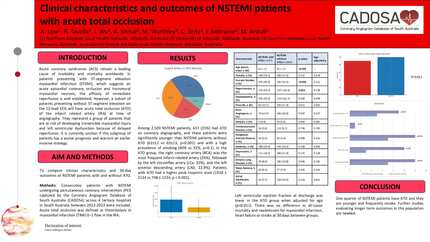
Among 520 NSTEMI patients, 49 (9.4%) were identified with ACO. These patients were younger compared to non-ACO patients (mean age 60.9 years ±12.8 vs. 66.3 ±12.0, p=0.0065), with no difference in sex distribution (male sex 81.6% vs. 72.4%, p=0.165). Dyslipidemia was less frequent in the ACO group (38.8% vs. 53.9%, p=0.043). Notably, revascularization was required significantly more often in ACO patients (93.9% vs. 82.2%, p = 0.037). Furthermore, culprit vessel distribution differed markedly between the groups (p < 0.0001), with the left circumflex artery (LCX) being predominant in the ACO group (49.0%), whereas the left anterior descending artery (LAD) predominated in the non-ACO group (52.3%). Baseline and clinical characteristics are summarized in picture 1.
In a subgroup analysis, ΑΙ-assisted ECG interpretation was performed on 42 out of the 49 admission ECGs with angiographically confirmed ACO. The algorithm classified each ECG according to the urgency of invasive management (immediate vs non-immediate). It also detected impaired left ventricular systolic function based on ECG analysis. Overall, 57.1% of cases were identified as requiring immediate invasive management. Among the remaining cases, 38.9% showed reduced LVEF<40%.
A significant proportion of NSTEMI patients present with ACO, highlighting the limitations of the traditional STEMI/NSTEMI classification. AI-assisted ECG interpretation may enhance earlier recognition and management of high-risk NSTEMI patients. Further research is certainly warranted to confirm these findings and to guide updated strategies. Baseline and clinical characteristics
Contributors


You may be interested in