Subendocardium-involved late gadolinium enhancement in non-ischemic dilated cardiomyopathy improves risk stratification of sudden cardiac death
European Heart Journal - Cardiovascular Imaging


Abstract
The prognostic value of late gadolinium enhancement (LGE) phenotypes-particularly subendocardial involvement-for sudden cardiac death (SCD) remains unclear in dilated cardiomyopathy (DCM). Whether LGE phenotype integrating pattern and location can improve SCD risk stratification is an unmet need.
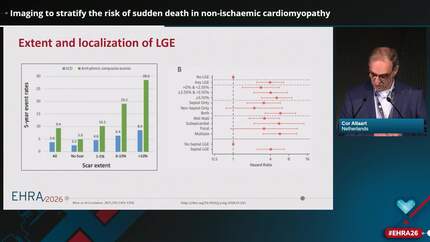
DCM patients who underwent cardiac MRI were retrospectively enrolled. The endpoint was a composite of SCD and surrogate SCD events. Among 902 patients (mean age 46 ± 14 years, 78.7% men), subendocardium-involved and mid-wall LGE were observed in 129 (14.3%) and 263 (29.1%) patients, predominantly involving the lateral (65.1%) and septal wall (97.7%), respectively. During a median follow-up of 77 months (IQR 40–92 months), 51 (5.7%) patients experienced SCD events. Multivariable analysis identified septal mid-wall LGE (HR 3.59; 95% CI 1.73–7.47;
SCD was predicted by both lateral subendocardium-involved LGE and septal mid-wall LGE in DCM. The novel SCD risk model integrating these phenotypes demonstrated superior prognostic performance compared with conventional prognosticators.
Contributors

Xi Jia
Author
Kankan Zhao
Author
Zhixiang Dong
Author
Xuan Ma
Author
Kai Yang
Author
Shujuan Yang
Author
Jiaxin Wang
Author
Yun Tang
Author
Zhuxin Wei
Author
Pengyu Zhou
Author
Yujie Liu
Author
Xingrui Chen
Author
Wenqing Xu
Author
Kaisaierjiang Aisikaier
Author
Fen Sa
Author
Xiuyu Chen
Author
Shihua Zhao
Author
State Key Laboratory of Cardiovascular Disease, Fuwai Hospital, National Center for Cardiovascular D Beijing , China
You may be interested in