A randomized, double-blind, crossover study of acute low-level night-time road traffic noise: effects on vascular function, sleep, and proteomic signatures in healthy adults
Cardiovascular Research


Abstract
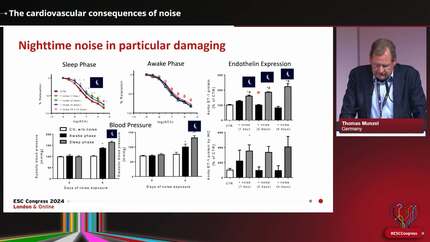
Road traffic noise is the dominant source of environmental noise in Europe and a recognized cardiovascular risk factor, yet direct mechanistic evidence from human studies remains limited. This study investigated the acute effects of low-level night-time road traffic noise exposure on cardiovascular parameters in healthy adults.
In a randomized, double-blind, crossover design, 74 healthy participants were exposed to three overnight conditions: control (no noise, average sound pressure level (LAeq) 30.70 dB), 30 (LAeq 41.36), and 60 (LAeq 44.13) recorded road traffic noise events (peak level ≈60 dB). The primary endpoint was endothelial function assessed by flow-mediated dilation (FMD) the morning after each night; a subgroup received vitamin C to assess oxidative stress involvement. Secondary endpoints included sleep quality (questionnaires), cardiovascular parameters (blood pressure, heart rate, electrocardiogram), and targeted proteomic analysis (Olink panels). FMD significantly decreased from 9.35% (control) to 8.19% after 30 noise events (Δ = 1.16%,
Acute exposure to night-time road traffic noise leads to measurable changes in cardiovascular health parameters in healthy adults. These effects were linked to activation of molecular pathways of immune signalling. Plasma proteome changes were correlated to FMD changes (responders vs. non-responders), highlighting interindividual biological susceptibility to noise.
Contributors


Patrick Foos
Author
Jonas Hübner
Author
Christina Große-Dresselhaus
Author
Frank P Schmidt
Author
Mir Abolfazl Ostad
Author
Marin Kuntic
Author
Lukas Hobohm
Author
Karsten Keller
Author
Volker H Schmitt
Author
Thomas Köck
Author
Philipp Wild
Author
Irene Schmidtmann
Author

Martin Röösli
Author
Paul Stamm
Author
Alexander von Kriegsheim
Author
Johannes Herzog
Author
Philipp Lurz
Author


You may be interested in