The blanking interval after atrial fibrillation ablation: time for reassessment with pulsed field energy
EP Europace Journal


Abstract
The clinical significance of early recurrences during the blanking period following pulmonary vein isolation (PVI) remains uncertain, particularly after pulsed field ablation (PFA). This study aimed to evaluate the prognostic impact of early recurrences at 30-, 60-, and 90-day thresholds on outcomes following PFA for atrial fibrillation (AF).
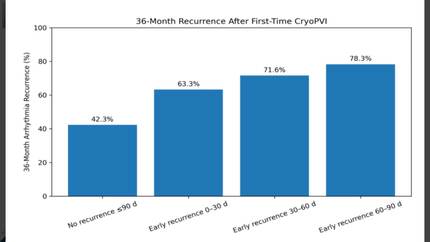
Consecutive patients who underwent PFA for AF across multiple centres within the Mayo Clinic health system were included. The primary endpoint was AF-free survival. Kaplan–Meier and multivariate Cox regression analyses were performed to compare outcomes between patients with and without early recurrences using 30-, 60-, and 90-day thresholds. A total of 1162 patients were included. The estimated AF-free survival at 1 year was 70%. Early recurrences within 30-, 60-, and 90-days post-ablation were significantly associated with late recurrences beyond 90 days (hazard ratio [HR] 5.9, 95% confidence interval [CI] 4.4–7.9,
Early recurrences following PFA are strongly predictive of long-term arrhythmia recurrence and are unlikely to represent transient inflammatory phenomena. Accordingly, the applicability of the conventional blanking interval after PFA should be reconsidered.
Contributors

Juan F Rodriguez-Riascos
Author
Hema S Vemulapalli
Author
James Y Kim
Author

Arturo M Valverde
Author
Mayank Sardana
Author
Abhishek J Deshmukh
Author
Suraj Kapa
Author
Chris Mcleod
Author
You may be interested in