A case report of giant coronary artery pseudoaneurysm and infective endocarditis: at what level can two pathologies be interconnected on a suitable background?
European Heart Journal - Case Reports


Abstract
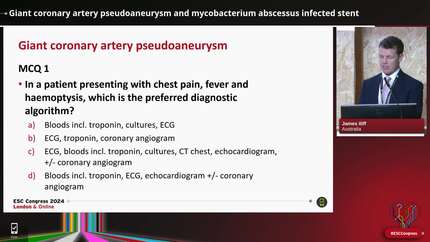
Coronary artery pseudoaneurysm (PSA) is a rare but potentially life-threatening condition, typically occurring after percutaneous coronary intervention (PCI). Giant coronary PSA in patients without prior coronary procedures is exceedingly uncommon. Mycotic involvement, particularly with
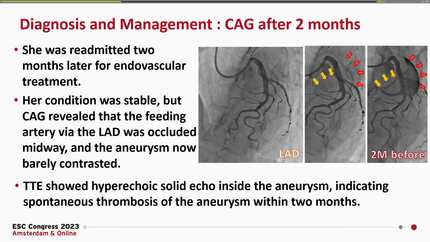
We report the case of a 38-year-old man on long-term haemodialysis who presented with unstable angina and new electrocardiographic changes. Coronary angiography revealed severe proximal left anterior descending artery stenosis with a giant PSA. Surgical repair was deemed prohibitive due to marked vascular fragility; thus, emergent PCI with covered stent implantation was performed, achieving satisfactory angiographic exclusion. The patient was discharged in stable condition. One week later, he returned with fever, haemoptysis, and sepsis. Imaging demonstrated a new pulmonary valve vegetation, establishing the diagnosis of infective endocarditis due to
This case illustrates the diagnostic and therapeutic challenges of a giant coronary pseudoaneurysm occurring in a haemodialysis patient without prior coronary intervention. Although infection was clinically recognized only after pseudoaneurysm treatment, the later development of
Contributors

Gabriela-Adelina Hoinaru
Author
Minodora Teodoru
Author
Oana Stoia
Author
Florin-Leontin Lazar
Author
Lina Ya'qoub
Author
Rasha Mohamed Abayazeed
Author
A Ashika
Author
Deepti Ranganathan
Author
You may be interested in