PO95
From myocarditis to non-dilated left ventricular cardiomyopathy: the decisive role of genetic testing in a young patient with syncope
European Journal of Preventive Cardiology


Abstract
Non-dilated left ventricular cardiomyopathy (NDLVC) is caused by pathogenic variants in desmosomal genes and typically manifests with ventricular arrhythmias or progressive heart failure. Distinguishing NDLVC from acute myocarditis, particularly in patients presenting with “hot-phase” episodes, remains a significant clinical challenge. Cardiac magnetic resonance (CMR) often demonstrates extensive late gadolinium enhancement (LGE), yet these findings can be nonspecific. In such scenarios, genetic testing provides critical diagnostic clarity and may influence decision-making.
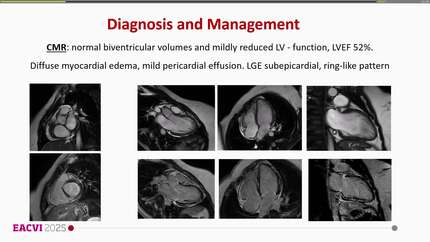
A previously healthy 19-year-old female was admitted following a syncopal episode, preceded by headache and transient visual disturbance. Laboratory evaluation showed elevated high-sensitivity troponin I (peak 2596ng/L), with no inflammatory response. Echocardiography was unremarkable. CMR revealed areas of subepicardial T2-STIR hyperintensity consistent with myocardial edema, together with extensive circumferential subepicardial/intramural LGE involving basal and mid-ventricular segments, only sparing the distal lateral wall. Left ventricular ejection fraction was mildly reduced (51%). Although these findings could be compatible with acute myocarditis, the disproportion between limited inflammatory signs and the broad LGE raised suspicion of an underlying NDLVC phenotype in its hot-phase. Genetic testing identified a likely pathogenic heterozygous truncating DSP variant (c.808C>T, p.Arg270*), previously reported in NDLVC and premature sudden cardiac death (SCD) in young individuals. This finding confirmed the diagnosis of NDLVC, reclassifying the episode as a hot-phase presentation. The genetic finding was pivotal for risk stratification and led to the implantation of an extravascular implantable cardioverter-defibrillator (ICD), in primary prevention. The patient remained stable and asymptomatic throughout follow-up. Cascade genetic testing of first-degree relatives was initiated.
This case illustrates the critical role of genetic testing in the diagnosis in young patients with myocarditis-like presentation and atypical imaging features. The detection of a pathogenic desmosomal variant, such as DSP, provides crucial diagnostic clarity by unmasking NDLVC and redefining patients SCD risk. In this case, genetic confirmation of NDLVC shifted management from supportive treatment for presumed myocarditis to targeted arrhythmic risk prevention. The presence of a pathogenic DSP variant, associated with premature SCD, combined with the syncopal event, justified early ICD implantation. Overall, this case underscores the importance of incorporating genetic testing early in the evaluation of young patients with ambiguous myocarditis-like presentations. Such an approach may expose concealed cardiomyopathy, refine risk stratification and enable timely interventions that may prevent SCD.
Contributors

Bárbara Lage Garcia
Author
Emídio Mata
Author
Margarida de Castro
Author
Luísa Pinheiro
Author
Sílvia Ribeiro
Author
Lucy Calvo
Author
Olga Azevedo
Author
António Lourenço
Author
You may be interested in