PO93
Shared splicing dysregulation in heart failure associated with dilated and ischemic cardiomyopathy and spatial specificity across cardiac regions
European Journal of Preventive Cardiology


Abstract
Alternative splicing is essential for cardiac development and function, and its dysregulation has been linked to heart failure (1). While splicing defects have been reported in dilated cardiomyopathy (DCM) and ischaemic cardiomyopathy (ICM)(2,3), the extent of their contribution to disease mechanisms and their spatial distribution across cardiac chambers remain incompletely understood.
This study aimed to characterise genome-wide splicing alterations in DCM and ICM, and to determine whether these changes act as disease drivers or represent consequences of pathological remodelling, with a focus on their distribution across distinct cardiac regions.
RNA sequencing was performed on left ventricular (LV) samples from patients with end-stage heart failure due to DCM (n=10), ICM (n=11), and non-failing controls (n=5). Splicing events were analysed using three complementary bioinformatic tools. Six candidate events in genes with established roles in cardiac physiology were validated by quantitative PCR across an extended cohort (54 DCM, 45 ICM, 23 controls) and three cardiac regions: LV, right ventricle (RV), and interventricular septum (IVS). Motif enrichment analysis was conducted to explore potential splicing regulators.
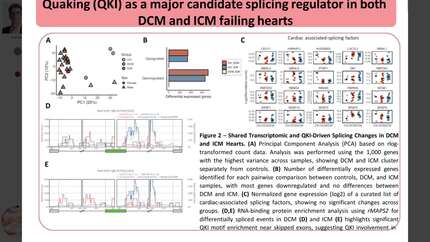
RNA-seq revealed widespread splicing dysregulation in heart failure compared to controls, with extensive overlap between DCM and ICM. Validation confirmed consistent alterations in CAMK2D and PDLIM3 across LV, RV, and IVS in both conditions. By contrast, splicing events in MYL6, ESRRG, EYA4, and SORBS1 displayed distinct patterns: in DCM they were altered across all cardiac chambers, whereas in ICM they were largely confined to the LV. Motif analysis implicated the RNA-binding protein QKI as a potential regulator of the observed splicing changes.
This study provides the first comprehensive multi-chamber analysis of splicing in human heart failure, identifying reproducible alterations shared between DCM and ICM as part of a common response to advanced cardiac remodelling. Distinct spatial patterns emerged, with DCM showing diffuse chamber-wide dysregulation and ICM displaying LV-restricted alterations consistent with focal ischaemic injury. These findings support the view that splicing dysregulation represents a shared molecular response to advanced cardiac remodelling, rather than a driver of aetiology-specific pathology, while also highlighting its role as a hallmark of end-stage heart failure and a basis for linking chamber-specific molecular profiles with clinical outcomes.
Contributors

Marta Furtado
Author
Pedro Barbosa
Author
Ana Wemans
Author
Lu Zhang
Author
Teresa Carvalho
Author
Patrícia Napoleão
Author
Przemyslaw Leszek
Author
M Carmo-Fonseca
Author
Yvan Devaux
Author
Sandra Martins
Author
You may be interested in