PO92
Expanding the genetic landscape of hypertrophic cardiomyopathy: patient-derived cardiomyocytes with deep intronic MYBPC3 variants recapitulate key disease features in vitro
European Journal of Preventive Cardiology


Abstract
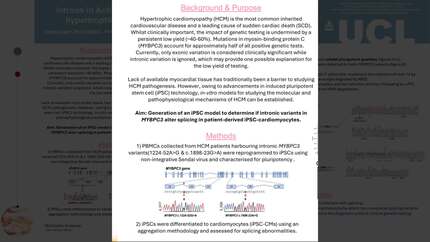
Hypertrophic cardiomyopathy (HCM) is the most common inherited cardiovascular disease, with mutations in MYBPC3 frequently implicated. Notwithstanding advances in sequencing strategies, up to 60% of individuals remain genetically undiagnosed which limits the clinical utility of testing. This may be partly explained by the current exon-centric approach to testing, which overlooks intronic and non-canonical variation for which accumulating evidence suggest a role in causing or modifying the HCM phenotype. Our previous work has shown that two deep intronic MYBPC3 variants, c.1224-52G>A and c.1898-23A>G, cause mis-splicing in patient derived iPSC-CMs, warranting further investigation into the consequences at the cellular level.
Herein, we aimed to functionally characterise patient-derived iPSC-CMs harbouring the aforementioned deep intronic MYBPC3 variants to identify mis-splicing induced morphological and physiological abnormalities consistent with the HCM phenotype.
Patient-derived iPSC-CMs were subjected to characterisation assays to assess contractility, calcium handing ability, MYBPC3 protein levels by western blot, and cellular morphology and sarcomeric arrangement by immunocytochemistry.
Our data demonstrates that cells carrying each variant, respectively, exhibit features consistent with the HCM phenotype. Reduced levels of full length MYBPC3 were observed for both variants, with no evidence of truncated protein, which fails to support normal cardiomyocyte structure and function and suggestive of a haploinsuffiency mechanism of disease. This agrees well with current literature regarding the pathomechanism of MYBPC3-HCM. Specifically, cells harbouring the c.1224-52G>A variant exhibit hypertrophy, improper incorporation of MYBPC3 into the sarcomere, diastolic dysfunction of prolonged relaxation, and prolonged calcium decay. While the phenotype of c.1898-23A>G cells was less pronounced, cells likewise demonstrated prolongation of relaxation, cellular hypertrophy, and delayed calcium decay. Additionally, the presence of early afterdepolarisations was a notable electrophysiological feature associated with both variants.
Functional analysis of patient-derived iPSC-CMs with deep intronic MYBPC3 variants display key features of the HCM phenotype in vitro. These findings support in silico predictions of mis-splicing variants and highlights the potential of expanding genetic testing beyond traditional regions in genetically undiagnosed individuals.
Contributors

Joanna Jager
Author
Natalia Rojas-Galvan
Author
Oriol Gracia Carmona
Author
Mark Holt
Author
Melissa Amerudin
Author
Petros Syrris
Author
Luis Lopes
Author
Mathias Gautel
Author
Perry Elliott
Author
You may be interested in