PO90
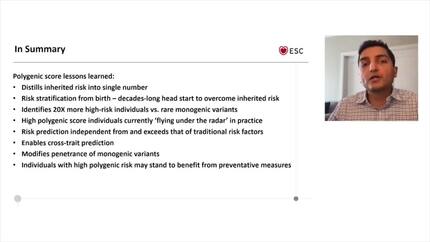
Is the polygenic risk score merely a research tool, or will it hold the potential to be a clinical instrument in cardiovascular prevention?
European Journal of Preventive Cardiology


Abstract
Cardiovascular disease (CVD) is the primary contributor to morbidity and premature death among adults worldwide. Despite advances in CVD risk prediction, it remains at high rates of incidence. The potential clinical utility of a polygenic risk score (PRS) for predicting the occurrence of cardiovascular events, particularly when combined with traditional risk tools, has been little explored.
To construct a polygenic risk score (PRS) to evaluate its potential clinical utility in detecting the occurrence of cardiovascular events, especially when combined with a traditional clinical risk tool (SCORE2), in a Portuguese Population.
A prospective study with 1,103 asymptomatic participants, without apparent CVD or diabetes, aged ≥40 to ≤65 years, was assessed during a long-term follow-up period (2001–2018). SCORE2 was calculated based on CVD risk estimations in a moderate-risk European region. To construct the PRS, we used 33 SNPs from the GENEMACOR study, genotyped with TaqMan allelic discrimination assay (Applied Biosystems). SNPs with HR≥1 were selected, and a weighted risk score was calculated by summing these risk alleles multiplied by their respective event risks (HR). Primary outcomes were acute coronary syndrome, ischemic stroke, peripheral vascular disease, atherosclerotic aortic disease, and CV death. Two models were constructed: model 1, with SCORE2 and model 2, integrating PRS. Kaplan-Meier estimated the occurrence of events during follow-up using two PRS categories (below and above median) and three SCORE2 categories (low, intermediate and high). Cox regression analysed the effect of SCORE2 and PRS on the risk of CV events. Harrell's C-statistic evaluated the discriminative ability of the models. As a reclassification measure, we used categorical free Net Reclassification Improvement (cfNRI).
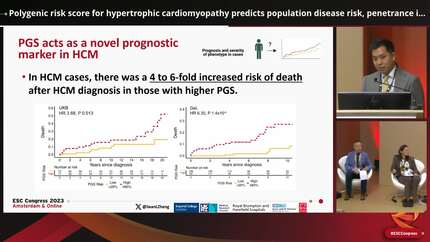
The mean value of SCORE2 in our population was 6.0±3.4 and 11.2±2.9 for PRS. During follow-up, 59 CV events (5.3%) were registered. Kaplan-Meier curves showed that PRS higher than median had a worse survival probability throughout the follow-up period (p=0.013). Cox regression analysis, SCORE2 and PRS remained in the equation with an HR=1.21 (p<0.0001) and HR=1.16 (p=0.001), respectively. Model 1 showed a C-index of 0.75 (95%CI:0.68-0.82) and model 2 of 0.80 (95%CI:0.75-0.85) (ΔC-statistic=0.049;p=0.001). After cfNRI, model 2 with PRS was able to improve reclassification of 21.8% of subjects to better categories (p=0.021).
Our findings suggest that adding a PRS to a traditional score may improve event prediction and discrimination, allowing better risk stratification, which could allow for an advanced change in lifestyle, delaying the onset of events, and improving survival. In brief, genetic information has stopped being a mere tool for research and has become an indispensable instrument to support clinical practice in CAD prevention.
Contributors

Gonçalo Abreu
Author
Maria Isabel Mendonça
Author
Débora Sá
Author
Francisco Sousa
Author
Matilde Ferreira
Author
Eva Henriques
Author
Sofia Borges
Author
Mariana Rodrigues
Author
António Drumond
Author
Ana Célia Sousa
Author
Roberto Palma dos Reis
Author
You may be interested in