Does helicopter transport delay prehospital transfer for STEMI patients in rural areas? Findings from the CRAC France PCI registry
European Heart Journal - Acute CardioVascular Care


Abstract
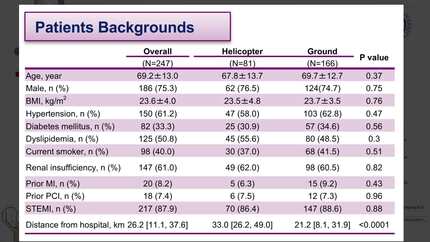
The aim of this study was to analyse delays in emergency medical system transfer of ST-segment elevation myocardial infarction (STEMI) patients to percutaneous coronary intervention (PCI) centres according to transport modality in a rural French region.
Data from the prospective multicentre CRAC / France PCI registry were analysed for 1911 STEMI patients: 410 transferred by helicopter and 1501 by ground transport. The primary endpoint was the percentage of transfers with first medical contact to primary percutaneous coronary intervention within the 90 minutes recommended in guidelines. The secondary endpoint was time of first medical contact to primary percutaneous coronary intervention. With helicopter transport, time of first medical contact to primary percutaneous coronary intervention in under 90 minutes was less frequently achieved than with ground transport (9.8% vs. 37.2%; odds ratio 5.49; 95% confidence interval 3.90; 7.73;
Helicopter transport of STEMI patients was five times less effective than ground transport in maintaining the 90-minute first medical contact to primary percutaneous coronary intervention time recommended in guidelines, particularly for transfer distances less than 50 km.
Contributors

Stephan Chassaing
Author
Marie Pascale Decomis
Author
Wael Yafi
Author
Christophe Laure
Author
Sandra Gautier
Author
Lucile Godillon
Author
Radwan Hakim
Author
Julie Akkoyun-Farinez
Author
Eric Revue
Author
Christophe Saint Etienne
Author
Denis Angoulvant
Author
Rene Koning
Author
Pierre Marcollet
Author
Pascal Motreff
Author
Leslie Grammatico-Guillon
Author
You may be interested in