PO54
Phenotype and outcome of Hypertrophic Cardiomyopathy patients with MYH7 Variants: a longitudinal Cohort Study
European Journal of Preventive Cardiology


Abstract
Hypertrophic cardiomyopathy (HCM) is primarily caused by mutations in MYH7 and MYBPC3 genes which exhibit diverse clinical expression and prognosis. This study aims to delineate the clinical features and long-term cardiovascular outcome of patients with MYH7-related HCM, and to look for clinical and prognostic implications of specific variants.
A retrospective longitudinal analysis was conducted on 30 unrelated HCM families with pathogenic/likely pathogenic (P/LP) MYH7 mutations. A composite endpoint encompassing heart failure hospitalisation, cardiovascular admissions, or all-cause mortality was evaluated. Kaplan–Meier survival analysis was used to compare outcomes across prevalent variants and genetic profiles.
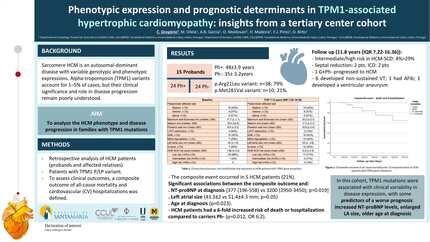
Among 118 individuals (30 probands, 88 relatives), 77 carried P/LP MYH7 variants — 69% with HCM (G+/Ph+) at diagnosis and 31% just carriers (G+/Ph-). Thirteen P/LP variants were identified, with four (p.Ile263Thr, p.Ala797Thr, p.Glu1356Lys, p.Arg663His) accounting for two-thirds of cases.
HCM patients had a mean age at diagnosis of 40.4±18.1 years and 49% were male. Baseline maximal wall thickness (MWT) was 18.6±0.8 mm, left atrial diameter (LAD) was 41.3±9.4 mm, and 23% exhibited resting left ventricular outflow tract obstruction (LVOTO); 68% had abnormal ECGs, but only one patient had atrial fibrillation (AF). Probands showed significantly larger LAD than relatives (p=0.004). A history of premature familial sudden cardiac death (SCD) was reported in 43% families.
During a median follow-up of 9.5 years (IQR 3.4-24.7, range 0.2-46.8 years), 35% of patients reached the composite endpoint, including 16 deaths (1 SCD) and 6 heart failure (HF) - related hospitalisations; 30% of patients developed AF, 17% received an ICD for primary prevention of SCD and 17% had a pacemaker implantation. Older age at diagnosis (p<0.01) and increased LAD (p=0.048) predicted poorer outcomes. The composite endpoint was similar between probands and relatives with HCM (p=0.08) and across the main variants (p=0.06). Overall penetrance was 70%, with only one carrier progressing to mild HCM.
ESC HCM Risk-SCD scores were similar across variants, both at baseline (p=0.60) and at last follow-up (p=0.29).
Most patients with MYH7-related HCM presented with a benign phenotype over the long term. Nonetheless, the risks of AF, SCD, and worsening HF throughout life justify regular monitoring, and the need to look for particular genetic profiles that may help tailored management strategies.
Contributors

Catarina Gregorio
Author
Marta Vilela
Author
Ana Beatriz Garcia
Author
Oana Moldovan
Author
Hugo Madeira
Author
Fausto J Pinto
Author
Dulce Brito
Author
You may be interested in