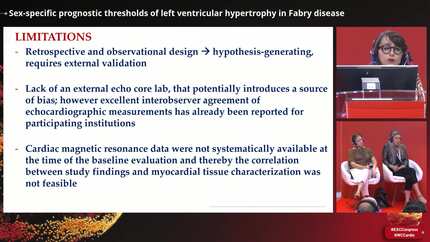
Sex-specific prognostic thresholds of left ventricular hypertrophy in fabry disease
European Heart Journal - Cardiovascular Imaging


Abstract
Left ventricular hypertrophy (LVH) is one of the main prognostic factors in Fabry disease (FD). Despite the known impact of sex on the phenotypic expression of the disease, a ‘fixed’ threshold of left ventricular maximal wall thickness (LVMWT) > 12 mm is conventionally used for defining overt cardiac involvement. We aimed to investigate sex-differences in the association between LVH degree and cardiovascular outcomes in FD.
In this multicenter retrospective study, 347 patients with FD (57% women) were enrolled and echocardiographic data collected. The study endpoint was defined as the composite of mortality, hospitalization for heart failure, atrial fibrillation, major brady- or tachy-arrhythmias and ischaemic stroke. Women had lower LV wall thickness and LV mass than men and these differences were confirmed also indexing for body surface area (BSA) (all
In FD patients, sex-specific prognostic thresholds of LVH were identified, with women experiencing cardiovascular events at significantly lower values of LVMWT than men, even after accounting for BSA.
Contributors

Maria Chiara Meucci
Author

Annamaria Del Franco
Author
Emanuele Monda
Author

Raffaello Ditaranto
Author
Maria Alessandra Schiavo
Author
Vanda Parisi
Author
Antonella Lombardo
Author

Letizia Spinelli
Author
Francesco Cappelli
Author
Antonio Pisani
Author
Guido Iaccarino
Author
Maurizio Pieroni
Author
Giuseppe Limongelli
Author
Iacopo Olivotto
Author
Francesco Burzotta
Author
Francesca Graziani
Author
You may be interested in