External validation of the PMcardio AI-ECG model for detecting occlusion myocardial infarction in a portuguese cohort
European Heart Journal - Digital Health


Abstract
Timely and accurate detection of occlusion myocardial infarction (OMI) is critical to initiate prompt reperfusion therapy and improve clinical outcomes in acute myocardial infarction (AMI). Conventional ST-elevation myocardial infarction (STEMI) criteria, which rely on predefined electrocardiographic (ECG) patterns, are known to lack sensitivity for identifying acute coronary occlusion. Recently, artificial intelligence (AI) models capable of detecting OMI directly from 12-lead ECGs have emerged as potential tools to enhance early risk stratification. However, independent validation of such models across diverse populations remains limited, particularly in European real-world cohorts.
To evaluate the diagnostic performance of the PMcardio-OMI AI-ECG model for detecting OMI among patients presenting with AMI in a Portuguese tertiary care setting, and to compare its performance with expert ECG interpretation and STEMI criteria, using adjudicated clinical diagnosis as reference.
We retrospectively analysed 812 patients admitted with AMI in our hospital, between 2020 and 2024. Each patient underwent standard 12-lead ECG interpretation by the PMcardio-OMI AI model, experienced cardiologists, and application of STEMI criteria. The reference diagnosis of OMI was established through central adjudication based on clinical presentation, coronary angiography, and serial troponin measurements.
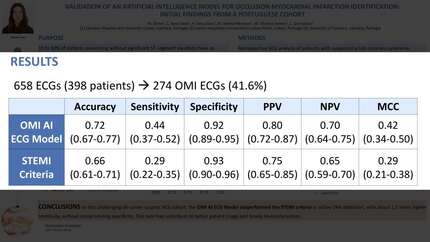
The study population had a mean age of 64 ± 13 years and was predominantly male (81.4%). OMI was diagnosed in 679 of 812 patients (83.6%). The PMcardio AI model achieved an accuracy of 63.3% (95% CI: 59.9–66.5), sensitivity of 58.9% (95% CI: 55.2–62.6), and specificity of 85.7% (95% CI: 78.8–90.7). Expert ECG interpretation demonstrated an accuracy of 64.8% (95% CI: 61.4–68.0), sensitivity of 59.8% (95% CI: 56.1–63.4), and specificity of 90.2% (95% CI: 84.0–94.2). STEMI criteria yielded an accuracy of 58.6% (95% CI: 55.2–62.0), sensitivity of 54.2% (95% CI: 50.4–57.9), and specificity of 81.2% (95% CI: 73.7–86.9).
In this external validation study from a real-world Portuguese AMI cohort, the PMcardio AI-ECG model exhibited moderate diagnostic accuracy for OMI detection. Its performance was comparable to that of experienced cardiologists and superior to standard STEMI criteria in terms of sensitivity, suggesting potential utility in supporting ECG-based triage. Notably, these results contrast with the findings reported in the previous study where the same AI model achieved a higher accuracy, sensitivity and specificity. This discrepancy highlights the need for local calibration and prospective multicentre validation to account for population-specific factors, clinical workflows, and ECG acquisition variability before widespread clinical implementation.
Contributors



You may be interested in