Fast-tracking cardiac amyloidosis detection from 12-lead ECG: validating the deep learning model willem AI platform
European Heart Journal - Digital Health


Abstract
Misdiagnosis and delay in diagnosis are frequent in patients with transthyretin cardiac amyloidosis (ATTR-CA). Methods from simple and accessible tests such as ECG are needed to better identify and treat patients. We sought to develop and optimize a deep-learning model based on the Willem AI platform to identify patients with ATTR-CA from 12-lead electrocardiograms (ECGs).
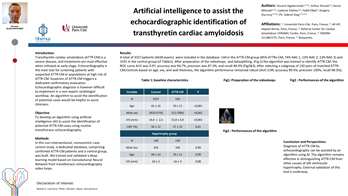
We analyzed ECGs from all subjects undergoing 3,3-diphosphono-1,2-propanodicarboxylic acid (DPD) scintigraphy for routine care assessment of ATTR-CA at Site01 from 2009 to 2023. 523 patients exhibited cardiac uptake and after complete assessment were diagnosed with ATTR-CA, whereas 2117 patients without DPD uptake constituted the control group. The Willem AI platform was optimized to discriminate between ATTR-CA patients and controls from 10 seconds 12-lead ECGs. A total of 9183 ECG records from all recruited subjects were used for model development and evaluation (ATTR-CA: 5237, 57.03%; controls: 3946, 42.97%), considering ECGs independently. 3707 ECGs from ATTR-CA and 2753 ECGs from controls were used for training and validation (70.30% of the total), and 1530 ECGs from ATTR-CA and 1193 ECGs from controls for testing (29.70%). The model generated its binary output based on features learned from ECG signals in the training dataset. Each ECG signal was normalized on a per-lead basis. Class weighting technique was used to adjust the loss function to cope with class imbalance, and the area under the Area Under the Receiver Operating Characteristic curve (AUROC) was considered as the main evaluation metric.
In the test dataset, AUROC for correct ATTR-CA classification was 0.841 (CI 95%: 0.826–0.856). Other performance metrics are represented in Table 1. The ROC curve is displayed in Figure 1. These results suggest the model has a good discriminative power to identify patients with ATTR-CA.
Willem AI platform identifies ATTR-CA patients using standard 12-lead ECGs with positive preliminary performance in this single-center study with a large dataset. Future work includes external validation in an ongoing multicenter european study to further evaluate model robustness and generalizability.
Contributors



E Gonzalez-Lopez
Author
F De Guio
Author

L Perard
Author
N Mora-Ayestaran
Author

R Lopez Garcia
Author
A De La Linde Valdes
Author
V Valdes
Author
J M Lillo-Castellano
Author
You may be interested in