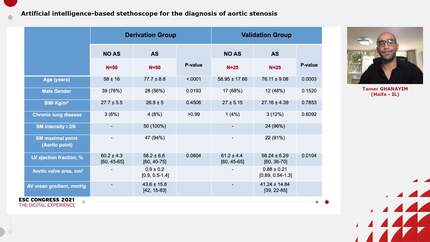
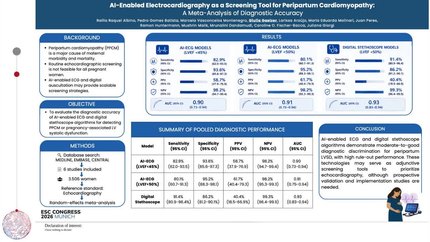
Artificial-intelligence-enabled digital stethoscope improves point-of-care screening for moderate-to-severe valvular heart disease
European Heart Journal - Digital Health


Abstract
Valvular heart disease (VHD) can affect more than one in two adults over 65 yet remains underdiagnosed due to the limitations of traditional auscultation. Earlier detection is critical for improving outcomes, but many cases go unrecognized. This study evaluates whether an artificial intelligence (AI)-enabled digital stethoscope can augment primary care providers’ (PCPs) ability to detect clinically significant VHD compared with analogue auscultation alone.
In this prospective study, 357 patients aged ≥50 years at risk for heart disease underwent both analogue cardiac auscultation by PCPs (standard of care, SOC) and digital cardiac auscultation by study coordinators followed by AI analysis using an electronic stethoscope (AI-augmented). Echocardiography and audible murmur annotation served as the reference standard. Sensitivity and specificity of AI vs. SOC were compared using Fisher’s exact test. The AI-augmented system demonstrated significantly higher sensitivity (92.3% vs. 46.2%,
Artificial intelligence–enabled digital stethoscopes significantly improve point-of-care VHD detection, offering a promising tool for earlier diagnosis and intervention in primary care settings.
Contributors

Moshe Rancier
Author
Igor Israel
Author
Vimalson Monickam
Author
Caroline Currie
Author
Ben Verschoore
Author
Emileigh Lastowski
Author
Douglas W Van Pelt
Author
John Prince
Author
You may be interested in