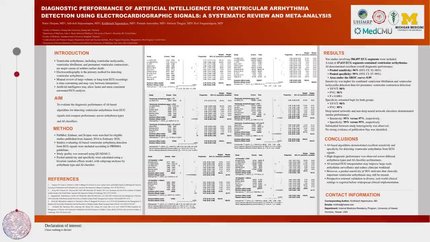
Machine learning for ventricular arrhythmia prediction: meta analysis
European Heart Journal - Digital Health


Abstract
Ventricular arrhythmia (VA), including ventricular tachycardia and ventricular fibrillation, are major contributors to sudden cardiac death. Despite the widespread use of implantable cardioverter-defibrillators (ICDs), preventive care is limited by their reactive nature. Machine learning (ML) has emerged as a promising tool to predict VA events before their onset.
To perform a meta-analysis quantifying the overall diagnostic accuracy of ML models in predicting the onset of ventricular arrhythmias.
We extracted performance metrics from 19 studies that developed ML models to predict VA events. Using reported sensitivity and specificity values, we computed corresponding true positives, false positives, false negatives, and true negatives. A bivariate random-effects model (Reitsma method) was used to derive the pooled area under the receiver operating characteristic curve (AUROC) using the "mada" package in RStudio. The summary ROC curve and 95% confidence region were visualized.
The pooled AUROC was 0.92 (95% CI: 0.87–0.95), indicating high diagnostic accuracy of ML based models for predicting ventricular arrhythmias. Most models were trained using ECG or heart rate variability features and applied algorithms such as support vector machines, artificial neural networks, and convolutional networks. The shape of the summary ROC curve suggests a consistent trade-off between sensitivity and specificity across studies.
ML based algorithms demonstrated excellent pooled predictive accuracy for predicting ventricular arrhythmias, with an AUROC approaching 0.92. These findings support the integration of ML into real time monitoring systems for arrhythmia risk stratification, thus enabling earlier intervention and improving patient safety. ROC figure for Meta analysis
Contributors



You may be interested in