Challenges in AVNRT ablation in a patient with previous atrio-pulmonary Fontan surgery: a case report
European Heart Journal - Case Reports


Abstract
Patients with complex congenital heart defects, such as tricuspid atresia, often require palliative surgical interventions like the Fontan procedure to optimize systemic and pulmonary circulation. While these surgeries improve survival rates, they are associated with long-term complications, including arrhythmias, due to significant anatomical and electrophysiological alterations. Among these, atrioventricular nodal reentrant tachycardia (AVNRT) is relatively uncommon but poses substantial challenges in diagnosis and management.
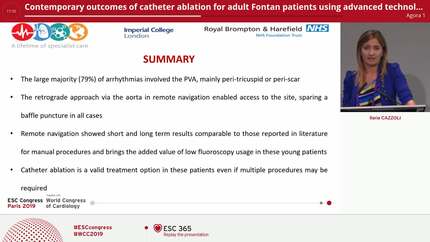
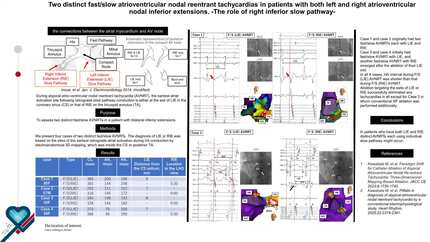
This case report describes a 36-year-old male with a history of tricuspid atresia and atrio-pulmonary Fontan surgery who presented with symptomatic recurrent palpitations. Electrophysiological (EP) study revealed an atypical variant of AVNRT, necessitating a complex ablation strategy. The unique anatomical considerations in this patient, including a hypoplastic right ventricle, a dilated and tortuous coronary sinus, and difficulty in defining the Triangle of Koch, complicated the identification of the compact atrioventricular (AV) node. Conventional catheter placement techniques were inadequate, and a retrograde aortic approach was employed to localize His bundle potentials on the left side of the septum. Advanced 3D electroanatomic mapping was used to construct a virtual geometry of the right atrium, which guided the identification and ablation of the slow pathway. Despite challenges in re-inducing the tachycardia during the procedure, successful slow pathway modification was achieved, and no recurrence of tachycardia was observed during follow-up.
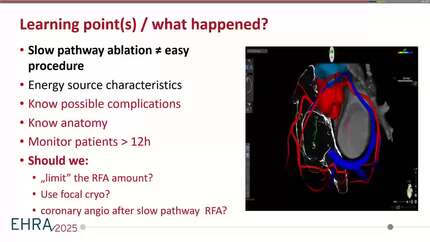
Fontan anatomy poses unique procedural risks and requires a multidisciplinary approach involving paediatric interventional cardiologists, radiologists, and electrophysiologists. The findings of this case underscore the critical importance of pre-procedural planning, detailed anatomical assessment, and advanced imaging techniques to achieve favourable outcomes.
Contributors

Avinash Jeewooth
Author
Aparna Jaswal
Author
Amitesh Chakravarty
Author
Felix Wiedmann
Author
Boldizsar Kovacs
Author
Inga Voges
Author
Nikesh Jathanna
Author
Deepti Ranganathan
Author
You may be interested in