Transthyretin amyloid cardiomyopathy: natural history and treatment response assessed by cardiovascular magnetic resonance
European Heart Journal


Abstract
Cardiovascular magnetic resonance (CMR) and extracellular volume (ECV) mapping can measure amyloid burden
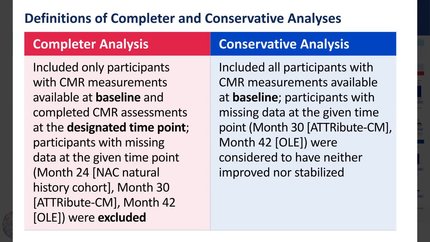
All 189 patients (untreated = 119, patisiran = 70) underwent assessment with CMR at baseline, 160 patients (untreated = 94, patisiran = 66) had a 1-year follow-up CMR and 75 patients (untreated = 42, patisiran = 33) had a 2-year follow-up CMR, of whom 36 patients (untreated = 17, patisiran = 29) had follow-up CMR at both timepoints. CMR response was graded by change in ECV: progression (≥5% increase), stable (<5% change) and regression (≥5% decrease).
In untreated patients, 36% progressed at 1 year which significantly increased to 62% at 2 years. Mean increase in ECV of 4.1% (after 1 year) and 6.8% (after 2 years) was observed and associated with significant worsening in biomarkers and structural parameters. No significant difference in mean ECV was observed following treatment with patisiran at both timepoints. Stable ECV was observed in 88% of patients (after 1 year) and 100% of patients (after 2 years). Structural parameters remained stable following treatment. ECV progression after 1 year was independently associated with mortality after adjusting for known predictors (hazard ratio 2.021; 95% confidence interval 1.081–3.781;
CMR with ECV mapping can track changes in cardiac amyloid burden and treatment response in ATTR-CM, with changes in ECV being independently associated with outcomes.
Contributors

Rishi K Patel
Author
Buckinghamshire Healthcare NHS Trust Bucksinghamshire , United Kingdom of Great Britain & Northern Ireland

Adam Ioannou
Author
Awais Sheikh
Author
Yousuf Razvi
Author
Josephine Mansell
Author
Ana Martinez-Naharro
Author
Daniel Knight
Author
Tushar Kotecha
Author
Aldostefano Porcari
Author
Liza Chacko
Author
James Brown
Author
Charlotte Manisty
Author
James C Moon
Author
Helen J Lachmann
Author
Ashutosh Wechalekar
Author
Carol Whelan
Author
Lucia Venneri
Author
Peter Kellman
Author
Philip N Hawkins
Author
Julian D Gillmore
Author

Marianna Fontana
Author
University College London London , United Kingdom of Great Britain & Northern Ireland
You may be interested in