Aspirin dosing after acute coronary syndrome with suspected aspirin resistance: the ANDAMAN trial
European Heart Journal


Abstract
Despite current antithrombotic treatments, the recurrence of ischaemic events remains high in patients with diabetes mellitus (DM) or aspirin resistance after acute coronary syndrome (ACS). Whether twice-daily aspirin dosing reduces major adverse cardiovascular events (MACE) in this population remains unknown.
In this prospective multicentre, randomized trial, patients with ACS and DM or high-risk of aspirin resistance (HRAR) defined as: (i) an index event occurring while on aspirin; (ii) body mass index ≥27 kg/m2; or (iii) increased waist circumference were assigned to receive enteric-coated aspirin once daily (100 mg/day) or twice daily (100 mg morning and evening). The primary outcome was MACE, a composite of any death, myocardial infarction, stroke, urgent coronary revascularization, stent thrombosis, or acute arterial thrombotic event assessed using a time-to-first-event analysis. The main secondary outcome was major bleeding (Bleeding Academic Research Consortium type 3–5).
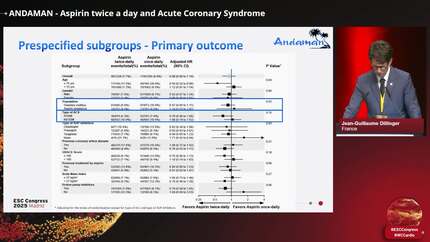
In total, 2484 participants were enrolled (77.2% with DM, 55.5% with ST-elevation segment myocardial infarction). The median follow-up duration was 18 (interquartile range: 17.6–18.3) months. The primary outcome occurred in 95 of 1228 participants (7.7%) in the twice-daily aspirin group, and 110 of 1256 (8.8%) in the once-daily group (hazard ratio [HR] 0.90; 95% confidence interval [CI] 0.69–1.19;
In patients with ACS and DM or HRAR, twice-daily aspirin did not significantly reduce the risk of MACE compared to once-daily dosing. No significant difference was observed in major bleeding between groups.
NCT02520921/EUDRACT No: 2015-000947-18.
Contributors

Patrick Henry
Author
Aboyans Victor
Author
Angoulvant Denis
Author
Batias Laure
Author
Jean-Guillaume Dillinger
Author
Belle Loic
Author
Bellemain-Appaix Anne
Author
Benamer Hakim
Author
Théo Pezel
Author
Beygui Farzin
Author
Bihry Nicolas
Author
Laure Batias
Author
Bonnefoy-Cudraz Eric
Author
Brunel Philippe
Author
Carrie Didier
Author
Denis Angoulvant
Author
Marc Goralski
Author
Cayla Guillaume
Author
Emile Ferrari
Author
Chague Frédéric
Author
Guillaume Cayla
Author
Coste Pierre
Author
Johanne Silvain
Author
Martine Gilard
Author
Cottin Yves
Author
Gilles Lemesle
Author
Cuisset Thomas
Author
Delarche Nicolas
Author
Géraud Souteyrand
Author
Derimay François
Author
Pascal Lim
Author
Dib Jean Claude
Author
François Roubille
Author
Jean-Louis Georges
Author
Dillinger Jean-Guillaume
Author
Claire Bal dit Sollier
Author
Ducrocq Gregory
Author
Elbaz Meyer
Author
Ferrari Emile
Author
Thibaut Petroni
Author
Olivier Morel
Author
Nicolas Delarche
Author
Georges Jean-Louis
Author
Meier Elbaz
Author

Gilard Martine
Author
Solenn Toupin
Author
Goralski Marc
Author
Gilles Montalescot
Author
Goube Pascal
Author
Hauguel-Moreau Marie
Author
Ludovic Drouet
Author
Eric Vicaut
Author
Henry Patrick
Author
Houssany-Pissot Sonia
Author
Lebreton Hervé
Author
Lemesle Gilles
Author
Lim Pascal
Author
Maillard Loic
Author
Mitchell-Heggs Laurens
Author
Montalescot Gilles
Author
Morel Olivier
Author
Petroni Thibault
Author
Pezel Théo
Author
Prunier Fabrice
Author
Puymirat Etienne
Author
Roubille François
Author
Sanguineti Francesca
Author
Schiele François
Author
Silvain Johanne
Author
Souteyrand Geraud
Author
Steg Philippe Gabriel
Author
Tron Christophe
Author
Varenne Olivier
Author
You may be interested in