Vericiguat and mortality in heart failure and reduced ejection fraction: the VICTOR trial
European Heart Journal


Abstract
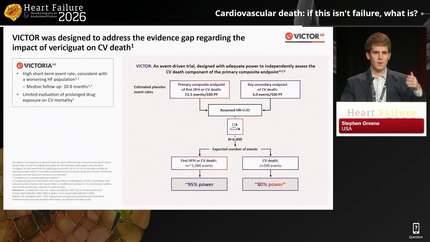
In the VICTOR trial (NCT05093933), vericiguat was neutral for the primary composite endpoint of cardiovascular death or hospitalization for heart failure (HF). VICTOR was powered to independently assess cardiovascular death. This study reports detailed analysis on the effects of vericiguat on mortality.
VICTOR, a double-blind, placebo-controlled, randomized trial, enrolled 6105 ambulatory patients with HF and reduced ejection fraction (HFrEF) without recent worsening and randomized them to vericiguat or placebo. The main outcome for this analysis was the pre-specified secondary endpoint of cardiovascular death. All-cause death, sudden cardiac death, and death related to HF were also assessed.
Over a median of 19.7 months (inter-quartile range 14.6–25.4), cardiovascular deaths occurred in 292 patients (5.7 deaths per 100 patient-years) and 346 patients (6.8 deaths per 100 patient-years) in the vericiguat and placebo groups, respectively (hazard ratio [HR] 0.83, 95% confidence interval [CI] 0.71–0.97;
In ambulatory well-treated participants with HFrEF, vericiguat was associated with clinically meaningful reductions in the key secondary outcome of cardiovascular death, as well as all-cause mortality.
Contributors



Ciaran J McMullan
Author
Kevin J Anstrom
Author
Irina Barash
Author
Marc P Bonaca
Author
Maria Borentain
Author
Stefano Corda
Author
Pedro P Teixeira
Author
Justin A Ezekowitz
Author
Davis Gates
Author
Carolyn S P Lam
Author
Eldrin F Lewis
Author
JoAnn Lindenfeld
Author
Robert J Mentz
Author
Christopher M O’Connor
Author
Piotr Ponikowski
Author
Yogesh N V Reddy
Author
Giuseppe M C Rosano
Author
Clara Saldarriaga
Author
Michele Senni
Author
James Udelson
Author
Alessia Urbinati
Author
Vanja Vlajnic
Author
Adriaan A Voors
Author
Aiwen Xing
Author
Mahesh J Patel
Author

You may be interested in