Long-term PM2.5 component exposure, genetic susceptibility, and myocardial infarction risk
European Journal of Preventive Cardiology


Abstract
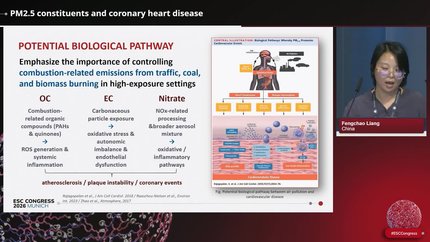
Associations between components of fine particulate matter (PM2.5) exposure and myocardial infarction (MI) risk remain unclear. The aim of this study was to investigate the connection between chronic PM2.5 component exposure and MI risk, as well as the impact of genetic susceptibility on these relationships.
This cohort study included 452 693 participants free of cardiovascular disease at baseline. Fine–Gray competing risk regression models were conducted to determine the links between PM2.5 components and MI risk, treating all-cause mortality as a competing event. The quantile-based g-computation was performed to identify the major contributor of PM2.5 components. A polygenic risk score was developed to reflect genetic susceptibility to MI. During a median follow-up of 11.75 years, 9327 participants have developed MI. Chronic PM2.5 component exposures were significantly associated with MI risk. The hazard ratios (95% confidence intervals) for each interquartile range increase were 1.171 (1.141, 1.202) for black carbon, 1.356 (1.332, 1.381) for ammonium, 1.073 (1.048, 1.100) for nitrate, and 1.232 (1.210, 1.254) for sulphate. Sulphate contributed most to the combined effects of PM2.5 components. Moreover, significant additive interactions and joint effects between genetic susceptibility and different PM2.5 components on MI risk were all observed.
Chronic PM2.5 component exposure was linked to an increased MI risk, and genetic susceptibility may modify these associations. Our study emphasizes the importance of implementing targeted pollution control strategies for different sources of PM2.5 components, as well as taking additional protective measures for populations at high genetic risk.
This study explored the single and combined effects of PM2.5 components on MI risk and further explored the roles of genetic susceptibility in these associations.
Exposure to PM2.5 components was associated with MI risk, and sulphate contributed most to the joint effect of PM2.5 components. Genetic factors interacted with PM2.5 components to increase MI risk.
Contributors

Ning Chen
Author
Yudiyang Ma
Author
Feipeng Cui
Author
Jianing Wang
Author
Linxi Tang
Author
Lei Zheng
Author
Meiqi Xing
Author
Xinru Zhao
Author
Jing Zhang
Author
Yaohua Tian
Author
You may be interested in