Endovascular mechanical thrombectomy vs. catheter-directed thrombolysis in pulmonary embolism: insights from the National Readmission Database
European Heart Journal - Acute CardioVascular Care


Abstract
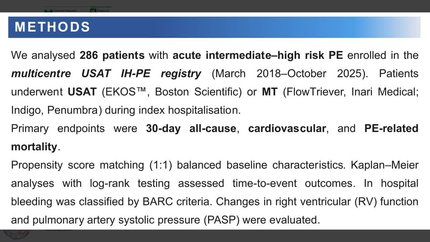
Catheter-based therapies for pulmonary embolism (PE), including endovascular mechanical thrombectomy (MT) and catheter-directed thrombolysis (CDT), are increasingly being used in clinical practice. However, real-world comparative data between these two modalities are scarce. We aimed to evaluate and compare the outcomes of MT and CDT in patients with PE.
This retrospective cohort study utilized the 2021 National Readmission Database (NRD) to identify adults with a primary diagnosis of PE who underwent either MT or CDT. The primary outcome was in-hospital mortality, while secondary outcomes included major bleeding, cardiac arrest, vascular complications, and post-discharge readmissions. Propensity-score matching was applied, followed by logistic and Cox-proportional hazard regression analyses. Subgroup analyses were conducted based on hospital procedural volume. After propensity-score matching, 7376 patients who underwent MT and 7355 who underwent CDT were included. MT was associated with higher odds of in-hospital mortality (4.4% vs. 3.4%; OR: 1.31, 95% CI: 1.01–1.68;
Endovascular CDT was associated with lower in-hospital mortality and major bleeding compared to MT in PE. As hospital procedural volume increased, both these outcomes improved, while difference in outcomes between MT and CDT reduced.
Contributors

Monil Majmundar
Author
Vidit Majmundar
Author
Vivek Bhat
Author
Kunal N Patel
Author
Gaurav Parmar
Author
Adam Alli
Author
Aaron Rohr
Author
Peter Monteleone
Author
Sanjum S Sethi
Author
Kamal Gupta
Author
You may be interested in