Comparison of readmission outcomes and complications between leadless and traditional transvenous pacemakers in older adults: a nationwide readmission analysis of 49852 admission events
EP Europace Journal


Abstract
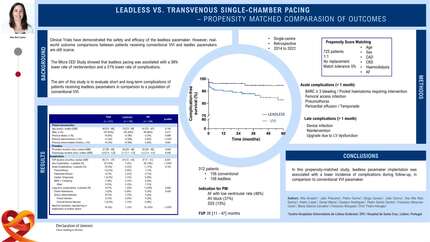
While transvenous pacemakers (TV-VVI) are standard for bradyarrhythmia, lead- and pocket-related complications remain concerns. Leadless pacemakers (LPMs) may reduce these risks. However, direct comparisons between LPMs and single-chamber TV pacemakers are limited. This study aimed to compare clinically meaningful outcomes between LPM and TV-VVI using real-world data.
Using the National Readmissions Database (NRD), we analysed demographics, readmission rates, and 30-day outcomes of patients aged ≥65 years who underwent LPM or TV-VVI implantation between 2016 and 2022. Admissions were identified via ICD-10 codes. Outcomes were assessed in the propensity score-matched population (10 594 patients per group) through multivariable logistic regression after 1:1 high-dimensional propensity score matching (caliper 0.1 SD) to adjust for confounding. Among 49 852 patients, 44.8% received LPM. Median age was 84 vs. 81 years in TV-VVI and LPM groups; 46.2% were female. TV-VVI patients had significantly higher rates of device-related complications [adjusted OR (aOR): 0.45, 95% CI (0.30–0.65),
Nationally representative data indicate that LPM implantation is associated with fewer device-related complications compared to TV-VVI, though further studies are needed to evaluate long-term outcomes.
Contributors

Jiaqi He
Author
Keting Liang
Author
Ruijian Huang
Author
Cunhua Su
Author
Jiancheng Zhou
Author
Lingli Wang
Author
You may be interested in