Polypharmacy on first admission to hospital for people with heart failure: baseline findings from the PULSE cohort
European Heart Journal - Quality of Care and Clinical Outcomes


Abstract
To define and characterize polypharmacy in people with heart failure.
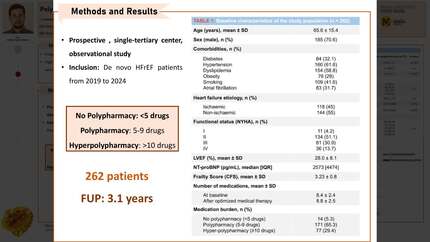
The PULSE dataset is a bespoke single centre, retrospective, longitudinal, observational cohort database of patients hospitalized for heart failure, capturing data from the first heart failure admission through to death or end of data collection, including all subsequent admissions. First admission with heart failure was used to define baseline polypharmacy. There were 660 patients included in the dataset, 55.6% male, mean age 76.1 (±SD 12.3). Median number of medications on admission was 9 (25th–75th centile 7–12) and on discharge 10 (25th–75th centile 8–13). Polypharmacy prevalence was 87.3% on admission, increasing at discharge to 95.1% (
Polypharmacy is common on first admission to hospital for people with heart failure. More medications at admission are associated with increasing age, co-morbidity, and frailty. People with polypharmacy are more likely to have a heart failure with preserved ejection fraction diagnosis, have worse symptoms and a longer hospital stay.
Contributors

Janine Beezer
Author
Sunderland Royal Hospital Sunderland , United Kingdom of Great Britain & Northern Ireland
Andrew L Clark
Author
Adam Todd
Author
Andrew Kingston
Author
John Casement
Author
Lucy Pages
Author
Andrew Husband
Author
You may be interested in