One-year prognosis according to BMI among heart failure patients with preserved and mildly reduced ejection fraction in Polish cohort - insights from HF-POL registry
European Heart Journal


Abstract
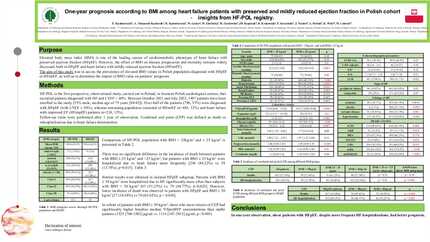
Elevated body mass index (BMI) is one of the leading causes of cardiometabolic phenotype of heart failure with preserved ejection fraction (HFpEF). However, the effect of BMI on disease progression and mortality remains widely discussed, both in HFpEF and heart failure with mildly reduced ejection fraction (HFmrEF). HF-POL registry is the first Polish multicenter, prospective, observational study concerning patients with left ventricular ejection fraction (LVEF) exceeding 40%.
The aim of this study was to access the prevalence of elevated BMI values in Polish population diagnosed with HFpEF or HFmrEF, as well as to determine the impact of BMI value on patients’ prognosis.
Between October 2021 and July 2022, 1497 (53% male) patients have been enrolled to the study (median age of 75 years [IQR: 68-82]. In this group, 796 patients (53%) were diagnosed with HFpEF (with LVEF >=50%), whereas remaining population consisted of HFmrEF (n=483, 32%) and heart failure with improved ejection fraction patients (n=218, 14%). Follow-up visits were performed after 1 year of observation. Primary end point was defined as death or rehospitalization due to heart failure exacerbation.
Median BMI was 29 kg/m2 [IQR: 26-33]. Patients with BMI >= 25 kg/m2 and BMI >= 30 kg/m2 accounted for 74% and 39% in overall HF-POL population, whereas in HFpEF for 76% and 41%, respectively.
Patients with BMI >= 25 kg/m2 had significantly lower concentrations of natriuretic peptides (NT-proBNP) (median 1417 pg/ml IQR:484-3444 vs. 2230 IQR: 896-5343, p<0,001).
There was no significant difference in the incidence of death between patients with BMI >=25 kg/m2 and <25 kg/m2, but patients with BMI >= 25 kg/m2 were hospitalized due to heart failure more frequently [244 (86.22%) vs 39 (13.78%), p=0.015].
Similar results were obtained in isolated HFpEF subgroup. Patients with BMI >=30 kg/m2 were hospitalized significantly more often [83 (51.23%) vs. 79 (48.77%), p=0,025] than subjects with BMI < 30 kg/m2. However, lower incidence of death was observed in patients with HFpEF and BMI >= 30 kg/m2 [37 (34.58%) vs 70 (65.42%), p= 0.038].
In one-year observation, obese patients with HFpEF, despite more frequent HF hospitalizations, had better prognosis. These patients presented more severe symptoms, which resulted in repetitive hospital admissions, but also in potentially earlier diagnosis of heart failure and start of cardioprotective treatment.
Contributors


A Tomaszuk
Author
R Kazimierczyk
Author
M Gasior
Author
M Gierlotka
Author
M Grabowski
Author
J D Kasprzak
Author
You may be interested in