Abstract
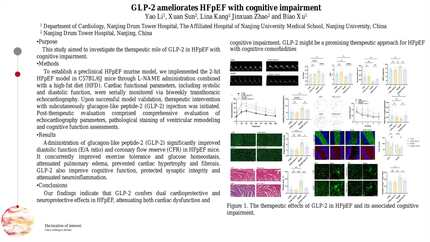
Heart failure with preserved ejection fraction (HFpEF) accounts for at least half of all heart failure cases and is characterized as a complex clinical and systemic syndrome. This condition is driven partially by chronic inflammation and influenced by aging, lifestyle factors, genetic predisposition, and multiple comorbidities1. Although left ventricular ejection fraction (LVEF) is preserved by definition in HFpEF, the prevalence of cognitive impairment in HFpEF parallels that observed in heart failure with reduced ejection fraction (HFrEF)2,3. However, research specifically focusing on cognitive dysfunction within the HFpEF population remains scarce, making the treatment of heart failure and cognitive impairment in HFpEF an urgent issue to be addressed4. Glucagon-like peptide-2 (GLP-2), an endocrine peptide secreted by intestinal L-cells, has demonstrated potential in restoring gut microbiota homeostasis and mitigating bacterial translocation5. This study aimed to investigate the therapeutic role of GLP-2 in HFpEF with cognitive impairment and elucidate the gut microbiota as a key mechanistic mediator.
To establish a preclinical HFpEF murine model, we implemented a dual-pathogenesis induction protocol in C57BL/6J mice through chronic L-NAME administration combined with a high-fat diet (HFD). Cardiac functional parameters, including systolic and diastolic performance, were serially monitored via biweekly transthoracic echocardiography. Upon successful model validation, therapeutic intervention with subcutaneous glucagon-like peptide-2 (GLP-2) was initiated. Post-therapeutic assessments comprised comprehensive evaluation of hemodynamic indices, pathophysiological markers of cardiac insufficiency, and cognitive function to quantify treatment efficacy.
Glucagon-like peptide 2 administration significantly improved HFpEF mouse diastolic function (E/A ratios), coronary flow reserve (CFR). It enhanced exercise capacity and glucose tolerance, reduced pulmonary edema, lowered heart failure biomarkers (ANP and BNP), and suppressed pro-inflammatory cytokines (TNF-α, IL-6). GLP-2 effectively attenuated cognitive deficits by Morris water maze. Consistent with these changes, immunofluorescence staining analyses revealed diminished synaptic loss and microglia-mediated neuroinflammation following GLP-2 treatment. Resting-state functional MRI (rs-fMRI) demonstrated restoration of hippocampal functional connectivity, correlating with improved synaptic integrity and reduced neuroinflammation.
Our study highlights the paramount importance that GLP-2 improves HFpEF heart failure and alleviate cognitive dysfunction, suggesting that GLP-2 may provide insights into therapeutic strategies for HFpEF with cognitive impairment GLP-2 treatment for HFpEF Graphical abstract

You may be interested in