Speckle tracking detects incipient myocardial systolic dysfunction in an experimental translational animal model of HFpEF
European Heart Journal


Abstract
The development of an experimental animal model of heart failure with preserved ejection fraction (HFPEF) is of great scientific interest to explore the pathophysiological mechanisms of myocardial dysfunction in this disease.
This study aimed to analyze left ventricular (LV) geometric and functional alterations in a translational model of HFpEF.
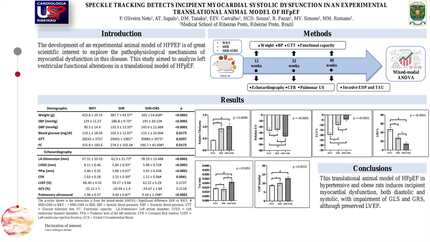
Rats with cafeteria diet-induced obesity and hypertension (SHR+OBS; n=23) were followed up for 40 weeks and compared with spontaneously hypertensive rats (SHR; n=23) and Wistar-Kyoto rats (WKY; n=23). Measurements were taken at three-time points (12, 32, and 40 weeks) and included body weight (BW), non-invasive blood pressure measurements (BP), fasting glucose and glucose tolerance test (GTT), functional capacity analysis, and pulmonary ultrasound (US). Cardiac geometry and function were assessed using echocardiographic and measurements of coronary flow reserve (CFR) and myocardial deformation was evaluated using the Speckle Tracking technique. At the end of the study invasive hemodynamic evaluation were carried out. The groups were compared using mixed-model ANOVA over time and post-test. Correlation tests were used as appropriate and significance was assumed if p <0.005.
The results are presented in the table. From 32 weeks up to the end of the study, the SHR+OBS group had higher BW and BP values compared to the WKY. They also showed a delayed reduction in blood glucose after GTT compared to the other groups. There were also clinical manifestations of HF in the SHR+OBS animals, measured by reduced functional capacity in the swimming test and signs of pulmonary congestion. The cardiac phenotype of the SHR+OBS animals revealed an increase in the dimensions of the left atrium and the relative thickness of the left ventricular (LV) wall, associated with signs of LV diastolic dysfunction (increased E/e' ratio), as well as a reduction in CFR when compared to the WKY, although similar to the SHR animals. LVEF remained preserved throughout all the time the studied. However, SHR+OBS animals showed significantly reduced values of global longitudinal (GLS) and global radial (GRS) myocardial strain, which was different even from animals in the SHR group. At the end of the experiment, SHR+OBS animals also showed significantly higher values of LV filling pressures (LVFP) and the Tau constant, even when compared to SHR animals.
This translational animal model of HFpEF in hypertensive and obese rats induces geometric remodeling and myocardial dysfunction, both diastolic and incipient systolic, with impairment of GLS and GRS, although preserved LVEF.
Contributors



You may be interested in