Pulmonary diffusion and congestion in heart failure with preserved ejection fraction
European Heart Journal


Abstract
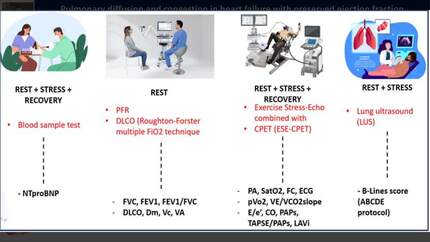
Patients with Heart Failure and preserved Ejection Fraction (HFpEF) are characterized by elevated left atrial pressures at rest and/or during exercise. This leads to an increase in pulmonary venous pressures and lung interstitial fluid accumulation, exacerbated especially during exercise. The role of lung diffusing capacity for carbon monoxide (DLco) and his subcomponent alveolar-capillary membrane conductance (Dm), as markers of fluid retention, are unexplored.
B-Lines evaluation of both hemithorax was realized at rest and immediately after combined ESE-CPET.
HFpEF group exhibited lower DLco and Dm at rest compared with controls and higher lung fluid accumulation during exercise with a significant correlation observed for HFpEF group but not for controls (Picture 1, A; DLCO: R = - 0,66, P < 0,001 ; Dm: R - 0,72 = , P < 0,001). We found also a good correlation between Dm and VE/VCO2 slope at CPET and E/e’ at peak of stress test in HFpEF group (Picture 1, B and C; respectively R = -0,48, P < 0,001 and R = - 0,7, P <0,001) expression of ventilatory/perfusion mismatch due to increase of lung extravascular water and elevation of left ventricular filling pressure during exercise.
In conclusion, HFpEF patients could have a chronic impairment of alveolar-capillary membrane function, a variable that predicts gas exchange impairment due to excessive lung extravascular water during effort.
Contributors


V Luberto
Author
G Crisci
Author
V Serrantoni
Author
F Nebiacolombo
Author
F Bursi
Author
L Massironi
Author
M Guazzi
Author
You may be interested in