Quality of life and symptom burden among patients with heart failure with preserved ejection fraction (HFpEF): variations by BMI categories
European Heart Journal


Abstract
Within the broad spectrum of heart failure (HF) with preserved ejection fraction (HFpEF), obesity-related HFpEF displays a distinct phenotype, yet is oftentimes underdiagnosed and undertreated. With the increasing prevalence of HFpEF and obesity, it is critical to have a comprehensive understanding of quality of life (QoL) and symptom burden among those with HFpEF and Obesity.
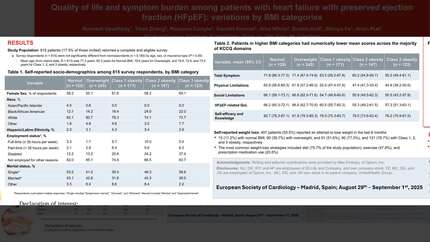
To describe HF related QoL, symptom severity, and physical limitations among adults diagnosed with HFpEF and stratified by BMI category.
This observational cross-sectional survey study identified participants in July 2024 from a large claims dataset. The target population included patients aged ≥ 18 years, with ≥ 6 months of continuous enrollment prior to 07/01/2024, and diagnosed with HFpEF between 10/01/2018 – 05/31/2024. A complex sample of 6,000 patients was taken from the target population. Patients were stratified on claims-recorded body mass index (BMI) categories (normal, overweight, class 1, 2 and 3 obesity), race (White and non-White), and HFpEF visit type. The strata within each BMI category contained a combined 1,200 patients; non-White patients were over sampled and patients with an outpatient without cardiologist visit type were under-sampled. The patient self-administered survey included the Kansas City Cardiomyopathy Questionnaire (KCCQ), a 23-item self-reported HF related health status measure that generates scores related to several domains including symptom burden, physical limitations and QoL ranging from 1 to 100 where higher score represents better health status. Descriptive analyses for the overall respondents and by patient-reported BMI categories were conducted, with analytic weighting applied to account for unequal probabilities of selection and nonresponse.
A total of 815 patients returned complete, eligible surveys, yielding an overall response rate of 17.5%. Of the 815 respondents, 16%, 30%, 21%, 18%, 15% patients were in normal, overweight, class 1, 2, and 3 obesity categories respectively (unweighted). Respondents and non-respondents were not significantly different on age, sex, and insurance type. Respondents had a mean (SD) age of 77 (9) years, 60% (95% CI hereafter: 56-65%) were female, 78% (75-81%) White. Most respondents reported being diagnosed with HF >5 years ago (42%; 37-46%). The mean KCCQ clinical and overall summary scores ranged from 51-68 and 53-67 respectively, with lowest score in the class 3 obesity category and highest in the normal weight category. Across the majority of KCCQ domains and the two summary scores, the means were numerically lower with increasing patient-reported BMI categories.
Lower quality of life, higher HF symptom burden, and more physical limitations were observed among survey participants with HFpEF who were in higher BMI categories compared to those who were in lower BMI categories.

You may be interested in