Worsening heart failure after primary catheter ablation in patients with atrial fibrillation with preserved ejection fraction: predictive value of HFA-PEFF score and H2FPEF score
European Heart Journal


Abstract
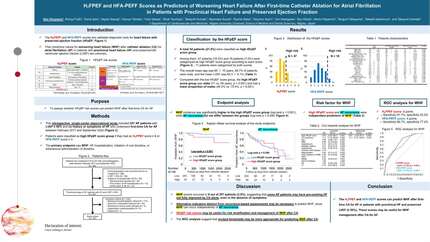
Atrial fibrillation (AF) is the most common cardiac arrhythmia and presents significant management challenges due to its potential complications. Catheter ablation (CA) is a standard treatment for symptomatic patients, particularly those unresponsive to medical therapy. However, long-term population studies report that nearly 50% of patients require hospitalization for AF or atrial flutter within 10 years post-ablation. Additionally, the hospitalization rate for heart failure is 1.1 per 100 person-years—relatively low but not negligible. AF patients often have a high prevalence of heart failure with preserved ejection fraction (HFpEF), contributing to heart failure progression. The H₂FPEF and HFA-PEFF scores are validated HFpEF risk stratification tools; however, their predictive value for heart failure outcomes after CA in AF patients remains unclear.
To evaluate the predictive value of the H₂FPEF and HFA-PEFF scores for worsening heart failure in AF patients undergoing primary CA.
This retrospective, single-center observational study was conducted at Niigata University Medical and Dental Hospital. A total of 338 AF patients with preserved left ventricular ejection fraction (LVEF > 50%) who underwent primary CA between February 2017 and September 2022 were included. Patients were classified as high-risk if they had an H₂FPEF score ≥6 or an HFA-PEFF score ≥5. The primary endpoint was worsening heart failure, while the secondary endpoint was AF recurrence. Kaplan-Meier survival analysis and Cox proportional hazards models were used to examine associations between the scores and outcomes. Sensitivity and specificity analyses assessed predictive accuracy. Statistical analyses were conducted using JMP Pro 17.
Among 338 patients, 97 (28.7%) were high-risk. The mean age was 66 ± 10 years, 68.0% were men, and median LVEF was 64.9%. High-risk patients were older (71 vs. 65 years, P < 0.001) and included fewer males (50.5% vs. 75.1%, P < 0.001). LVEF and AF pattern (paroxysmal or persistent) did not differ between groups. High-risk group had a significantly higher incidence of worsening heart failure than low-risk group (Log-rank P < 0.001), but AF recurrence did not differ between groups (Log-rank P = 0.186). Worsening heart failure was more common in the high-risk group regardless of AF recurrence (AF recurrence group: Log-rank P = 0.037, Non-AF recurrence group: Log-rank P < 0.001). Cox proportional hazards analysis identified a high H₂FPEF and HFA-PEFF score as an independent predictor of worsening heart failure (HR 4.78, 95% CI 1.94–11.76, P < 0.001). H₂FPEF score ≥6 predicted worsening heart failure with an AUC of 0.745, sensitivity of 71%, and specificity of 64%. HFA-PEFF score ≥5 had an AUC of 0.798, sensitivity of 75%, and specificity of 75%.
The H₂FPEF and HFA-PEFF scores effectively predict worsening heart failure in AF after primary CA, regardless of AF recurrence. Freedom from worsening heart failure
Contributors

S Fujiki
Author
S Sato
Author
K Tanaka
Author
Y Sekiya
Author
H Tsuchiya
Author
T Kumaki
Author
M Watanabe
Author
R Sakai
Author
H Kayamori
Author
T Takayama
Author
H Obata
Author
T Kashimura
Author
T Inomata
Author
You may be interested in