An alternative clinical score for the diagnosis of heart failure with preserved left ventricular ejection fraction in patients with atrial fibrillation
European Heart Journal


Abstract
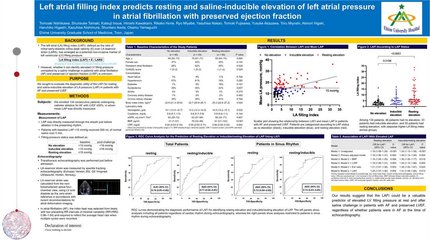
The study investigated the association of clinical and echocardiographic (ECHO) factors with the presence of heart failure with preserved left ventricular ejection fraction (HFpEF) diagnosed by invasively measured mean left atrial (LA) pressure (LAP) ≥15 mmHg.
We reviewed the data from 1473 patients who underwent catheter ablation for atrial fibrillation (AF) and had simultaneous hemodynamic measurements and high-quality ECHO examinations. The study group comprised 889 patients with left ventricular EF ≥50% and no significant valvular heart disease. We investigated multiple potential predictors of HFpEF, including all components of the previously established H2FPEF score.
Baseline characteristics of patients are shown in Table. A total 29.5% of cases underwent ≥1 prior AF ablation procedure. Sinus rhythm during ECHO examination and LAP measurement was present in 78% and 74%, respectively. Patients had a LAP of 9.7 ± 4.7 mmHg, and 13.7% of them fulfilled the criteria of HFpEF. Areas under the ROC curve (AUC) with optimal dichotomies are presented for all investigated factors (Table). Four independent predictors of HFpEF (multivariate linear regression model; R=0.34) were found: female gender, body mass index (BMI), LA volume, and global LA EF (Table). Of these, only BMI belongs to the historical H2FPEF score. In contrast, the other components of the H2FPEF score (age, antihypertensive therapy, E/Em ratio, and tricuspid regurgitation pressure gradient) were not independent predictors of HFpEF in our cohort. The sum of the risk points suggested by the regression analysis (Table) provided a risk score with AUC=0.756. Score ≥6 predicted HFpEF with a sensitivity of 53%, specificity of 85%, and positive and negative predictive values of 36% and 92%, respectively.
Female sex, higher BMI, larger LA volume, and lower global LA EF constitute a composite predictor of HFpEF that may serve as an alternative to the H2FPEF score. However, its predictive power for HFpEF (as with the H2FPEF score) is relatively low.
Contributors

K Kroupova
Author
M Kotrc
Author
P Stojadinovic
Author

J Kautzner
Author
V Melenovsky
Author
D Wichterle
Author
You may be interested in