Prognostic value of the combination of marasmus and kwashiorkor in patients admitted for acute decompensated heart failure with preserved ejection fraction
European Heart Journal


Abstract
Malnutrition is characterized by marasmus and kwashiorkor according to the mode of deficiency. However, the clinical significance of these aspects has been unclear in patients with heart failure with preserved ejection fraction (HFpEF). We investigate the prognostic value of the combination of these aspects in patients admitted for acute decompensated heart failure (ADHF) with HFpEF.
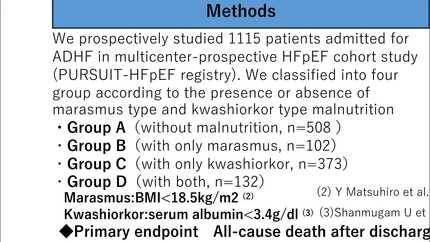
We prospectively studied 1115 patients admitted for ADHF in our multicenter-prospective HFpEF cohort study (PURSUIT-HFpEF registry), who were classified into four group according to the presence/absence of marasmus type malnutrition (body mass index < 18.5 kg/m2) and kwashiorkor type malnutrition (serum albumin < 3.4 g/dL) at time of discharge: Group A (without malnutrition. n=508), Group B (with only marasmus, n=102), Group C (with only kwashiorkor, n=373), Group D (with both, n=132). The endpoint was all-cause death (ACD).
During a follow-up period of 1110±551 days, 429 patients died. At multivariate Cox analysis, marasmus(adjusted HR;1.53[1.23-1.92] p<0.05) and kwashiorkor(adjusted HR;1.43[1.16-1.76] p<0.05) were independently associated with ACD after adjustment for confounders(age, gender, NYHA class, prior history of heart failure hospitalization, diabetes and coronary artery disease, creatinine, hemoglobin, and the content of heart failure medication such as beta-blockers, diuretics, mineral corticoid antagonist and sodium-glucose cotransporter-2 inhibitors ). Kaplan-Meier analysis revealed that Group D (adjusted HR; 2.77[2.08-3.67]) had the highest risk of all cause death after discharge compared to Group A, while Group B (adjusted HR; 1.62[1.16-2.26]) and Group C (adjusted HR; 1.88[1.50-2.35]) had intermediate risk.
Malnutrition classified by marasmus and kwashiorkor could predict poor prognosis in patents with ADHF-HFpEF.
Contributors

You may be interested in