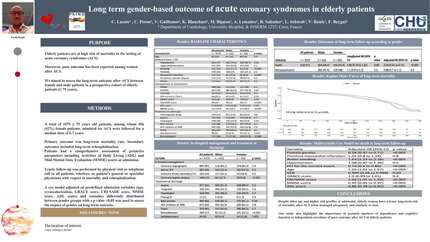
Gender-specific outcomes and treatment responses in elderly HFpEF patients: a comprehensive single-center retrospective study
European Heart Journal


Abstract
Heart failure with preserved ejection fraction (HFpEF) disproportionately affects elderly women, influenced by sex-specific hormonal and physiological factors that impact clinical presentation, comorbidities, and outcomes, necessitating tailored management strategies.
To evaluate sex-specific prognostic differences, comorbidity impacts, and guideline-directed medical therapy (GDMT) effects in elderly HFpEF patients.
Retrospective analysis of 603 patients (age ≥60, male: 51.6%, mean age: 79.10 ± 9.19 years) newly diagnosed with HFpEF at a university hospital, (From July 2019 to June 2024) with follow-up until December 2024. The primary outcome was all-cause mortality. Results
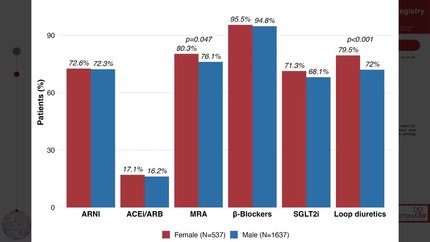
Over a median follow-up of 19 months (IQR: 10–30 months), overall mortality rate: 14.2/100 person-years (women: 15.4 vs. men: 13.2). Based on the Ge phenotype classification for HFpEF, Types I/IV-HFpEF had better survival (median 47.3/44.7 months) vs. Types II/III/V (38.8/36.8/34.9 months). Sex-specific mortality peaks differed: men (Type V: 30.3/100 person-years) and women (Type III: 28.2/100 person-years). Regarding comorbidities, diabetes mellitus (DM) and stages 4–5 chronic kidney disease (CKD) predicted mortality in men only (CKD: HR=3.237, DM: HR=2.336; both Adjust P<0.01), not women (Adjust P>0.1) in the Cox regression analysis after adjusting for age, sex, BMI, and hypertension. RAAS inhibitors and SGLT2 inhibitors improved survival, with sex-specific efficacy. However, further analysis among RAAS inhibitors showed this association was significant only for ARNI (HR 0.608, P=0.027). After adjusting for age, BMI, hypertension, and renal dysfunction, ARNI reduced mortality in women (HR 0.567, Adjust P=0.027), SGLT2 inhibitors in men (HR 0.247, Adjust P=0.021).
Mortality patterns, comorbidity impacts, and treatment responses in elderly HFpEF patients exhibit significant sex disparities. Phenotype-specific risks (Type V in men, Type III in women), male-predominant CKD/DM mortality associations, and sex-divergent GDMT efficacy (ARNI for women, SGLT2i for men) underscore the need for sex-tailored management to optimize outcomes.
Contributors



You may be interested in